The last few miles

After 53 days at sea we finally sighted land. In the distance we could vaguely make out the south Pacific islands of Hiva Oa and Mohotani. Our navigation had worked, they were exactly where they should be. As the day continued we sailed between the islands and began a race – us and the wind against the setting sun. Each hour we recalculated average speed and distance to run and each time the result was the same – we may be there before dark. No way were we entering an unknown, badly lit, full harbour at night.
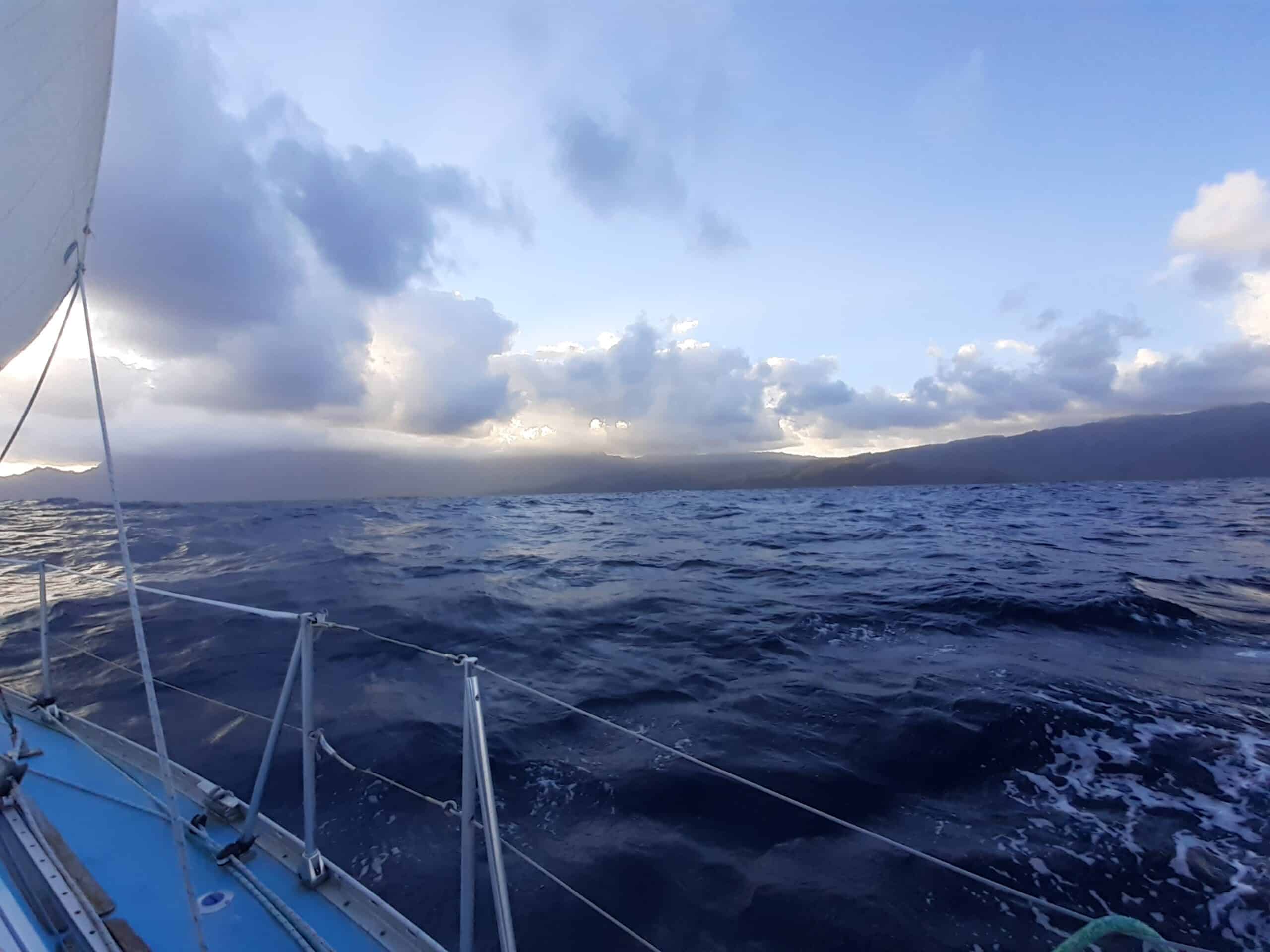
Hiva Oa to starboard

We prepared the stern anchor because all our information was that the bay at Atuona would be packed with boats stuck there by the Corona virus and, if we could find space, we would have to shoehorn ourselves in.

We called ahead on the VHF to try and finally get permission from the authorities to enter the country. But no one heard and no one answered.

Would there be any space? Would our depth sounder work after the Raymarine bus problems a month ago? Would we reach the bay before dark? Would we be spotted and turned away by the French navy? Would our engine work after seven weeks of inactivity?

The sun cheated by setting an hour early behind a mountain and we retaliated by starting the engine for the last three miles – it worked after a bit of cranking. In the twilight we found the marker that shows the entrance to the bay – although the lights on it were not working – and headed towards the shore. Finally, and to our great relief, the depth gauge began to work. On the first boat we passed a lady ran to the bow to inform us that the inner bay was full but to anchor by the breakwater.

We dropped anchor and within minutes the new neighbours were there in their dinghy bringing us fresh fruit and assuring us the locals would let us stay whatever the central government said.

We had sailed 4035 miles across the Pacific and were excited at our new achievement but now we were relieved and happy just to be at anchor.
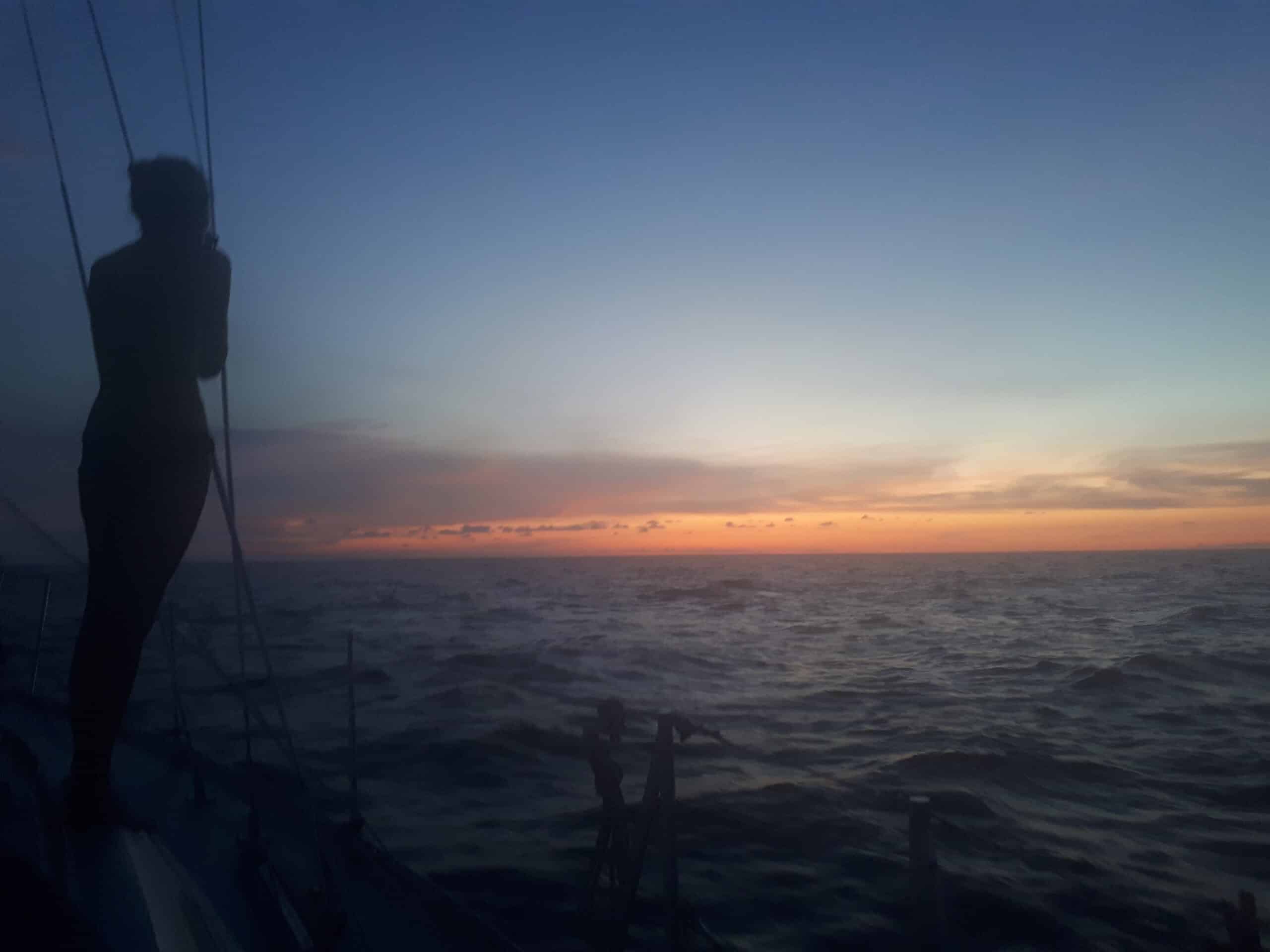
Last night at sea?

Tonight is our fifty third night at sea and it may be the last for this voyage.

We both find it hard to believe but maybe at first light tomorrow we will see the island of Hiva Oa before us. This has been our destination since we changed plan some 3000 miles ago. Back then it was so unimaginably far away and now it waits “just over the horizon”.

The last person we saw was a fisherman who begged food seven weeks ago. The last ship or vessel of any type was also six weeks ago. A few weeks ago we met a huge whale and there is always the occasional seabird or flying fish but basically we have been alone.

Maybe tomorrow we will see people or even talk to someone. Maybe smell vegetation or earth. And maybe sleep anchored to the seabed. Strange thoughts but we shall see.

Now we just enjoy another warm night under the well known stars by the light of a quarter moon.

Signposts in the sky

Woken up in the night with a coffee by Heidi to start my shift. Half moon was about 40° above the horizon so the time was roughly two in the morning. The southern cross was off to port (left) so our course was west. The water could be heard running past the hull so we were making over three knots in the correct direction.

We have all sorts of electronic toys on board. With the magic of GPS, we can be sure of the time to the second, our speed to a tenth of a knot and our position to about three meters. Nice – but irrelevant. The moon, the stars and the sounds of the boat tell us all we really need to know.

Two years ago, the northern star – Polaris – was our guide. A quick glance at the big dipper showed us where it was and we knew our course “good enough”. But Polaris long ago disappeared below the northern horizon and now we have new friends – Kruz, Garkruz and Arkruz, three points of a cross and Kantaurus and Hadar pointing towards them. New stars above a new ocean guiding us on to new lands.

Morning wake up call

Another morning in the Pacific. Over three hundred miles from Peru and two hundred off the Galapagos Islands. The sky is blue, the water is blue and we are brown – and in my case naked. Heidi has a bikini on but there is a huge rip in the back. We are lounging in the cockpit drinking coffee. Only another two thousand miles to Easter Island and getting less each day.

Then the AIS alarm sounds and the display starts blinking. Something is going to hit us in three minutes. We scan the horizon frantically but it is empty. The alarm stops and the ghost ship disappears off the screen.

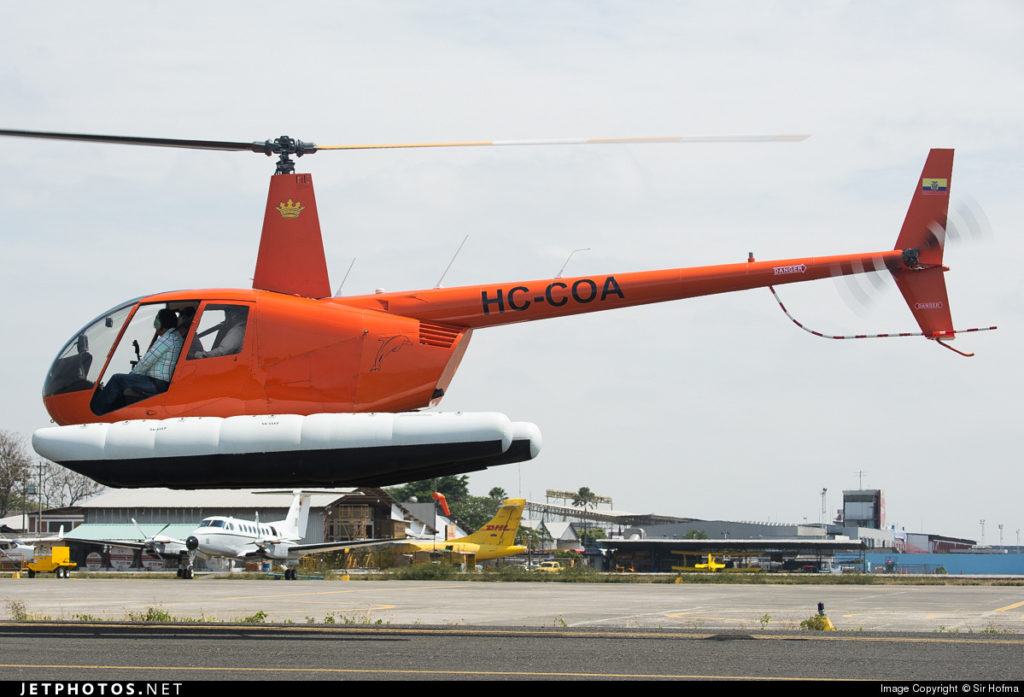
Barely have we sat down again and the alarm starts again. “HC-COA” is approaching at 80 knots and impact is imminent. We can see NOTHING! Heidi suggests a super fast submarine. I’m thinking cruise missile. We are both thinking “Shit!”

This is the helicopter that visited us.

And then Heidi spots a helicopter heading our way. I dive below to look for underpants. Keeping her bottom away from the helicopter, Heidi waves to the hovering pilots and they wave back. Then they are off again looking for some one else to terrify.

Safety lines can kill you.

We are now over 3000 kilometers away from the nearest continent – North America – and over 2000 kilometers from the nearest habitation – Easter Island. When the International Space Station passes overhead, the astronauts on board are our closest neighbours. We are “somewhat remote” and really don’t want anything bad to happen.

If we were to fall overboard, the one person remaining on board would need to stow the sails, start the engine and come back to look for our tiny head in between the swell. And calling for help is not an option out here. That is why we only leave the cockpit clipped in to a safety line.

Our lifejackets are clipped to strops and they are attached to jackstays that run from the cockpit to the bow. You can reach everything while firmly attached to the boat. Of course the lines jam and of course they are in the way but that is better than a last swim.

Safety lines – a death sentence for flying fish

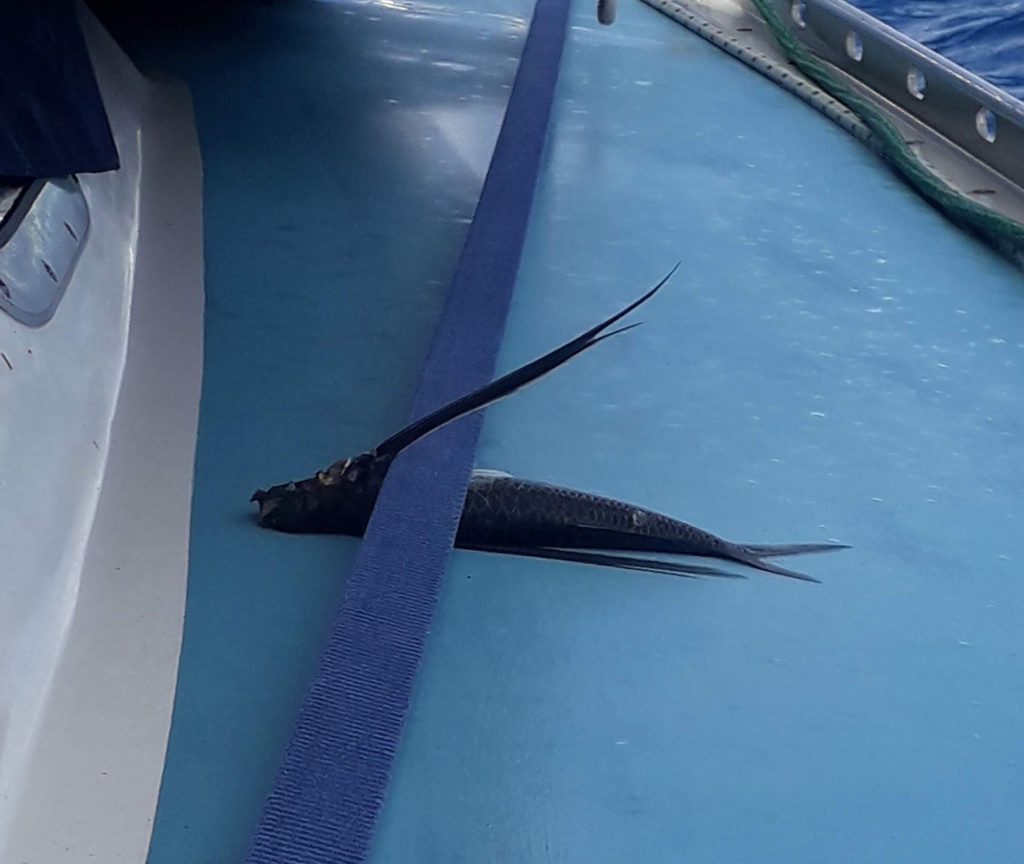
Each day we find dead flying fish on deck who have landed on the boat and got stuck. Yesterday we found a really unlucky example. It had got its wing jammed under the jackstay and was therefore “safely” attached to the boat. A great place for us; a bad place for “Biggles”.

Sunsights

Originally written somewhere in the Pacific

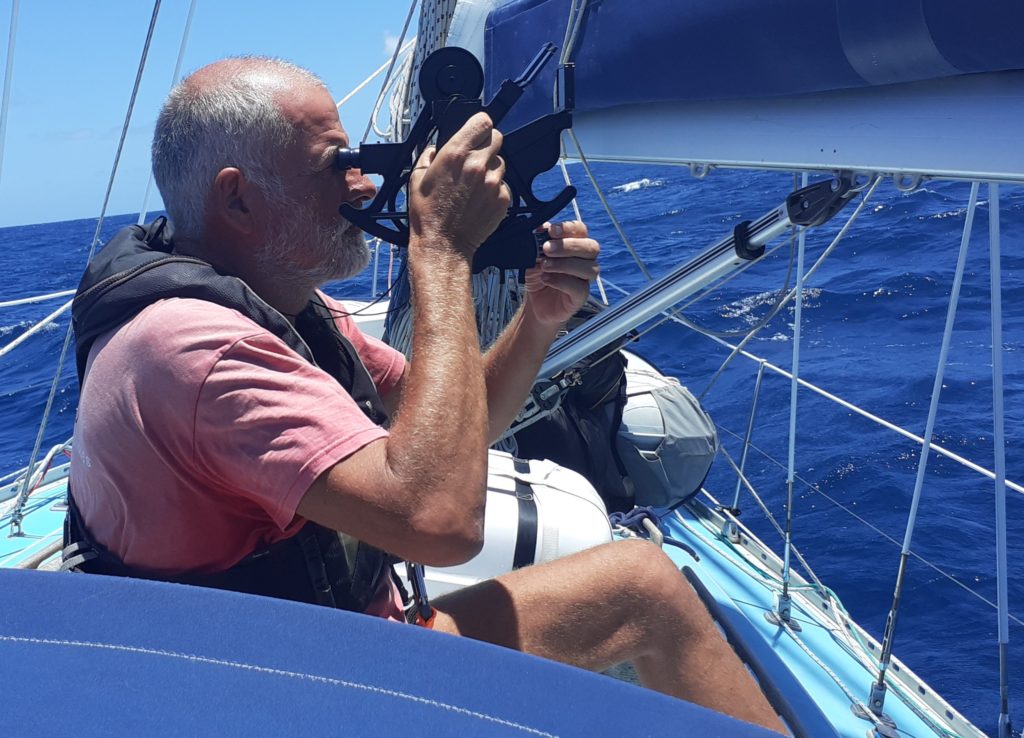
Sunsights are when you take your sextant and measure the height of the sun above the horizon. With this measurement, a bit of maths and some drawing lines on a chart; you can calculate your position. I have a great picture of two sailors stood on the deck of a ship taking their sights – and feel jealous every time I see it.

On a good day, I can sit comfortably on the coach roof with a clear view of both the sun and the horizon. I don’t remember such a day this trip. At the very least the boat is rolling so I need to jam myself in some where and the mainsail rocks gently in front of the horizon occasionally.

Jammed on the coach roof searching for the sun

Yesterday I was jammed in to a corner of the cockpit trying to sight the sun under the radar and the solar panels while the horizon disappeared behind the outboard motor and windvane. Occasionally there would be a clear view past everything and, if we were really lucky, no wave blocking the horizon and no cloud in front of the sun.

With two hands needed to operate the sextant I was falling over each time the boat rolled in the swell. Heidi, who also needed her hands free to write down times and measurements, jammed herself against me and held me tight. Together, we managed to take the sights and document them but it was a challenge.

Sunsights. Just another example of the difference between theory and practice.

The Pacific is huge

We have now been at sea for three weeks and have managed over a thousand miles. We have finally found the trade winds and are making over one hundred miles each day.

We sit out in the cockpit and look around us. At night the sky is filled with stars and the water is jet black. During the day the sea is a stunning shade of blue. And it is vast! As far as you can see there is no sign of humans. At night we see the occasional satellite but that is the only visual sign of mankind. Unfortunately during the day we occasionally pass a plastic bottle floating along proclaiming that people exist and don’t care about their planet.

Every day a new sunrise and then a new sunset.

When we look next to the boat, there are various fish escorting us. The shape and color changes but we always have an entourage. Even here, so far from land, there are birds and one spent a few days using our pulpit as a base for fishing trips. Eventually it disappeared, maybe to hitch a lift back to South America with another boat.

You take a look around at the huge view of emptiness, sleep half the night and when you wake there is still just a tiny boat surrounded by nothing; and that day after day. We are only a third of the way to the Marqusas so can expect this to continue for another three weeks at least.

The Pacific is truly huge.

Give me the wisdom …

Originally written at sea on 10. March 2020

Sometimes you see motivational posters saying something like

God, grant me the serenity to accept the things I cannot change,
courage to change the things I can,
and wisdom to know the difference.

That could have been written by a blue ocean sailor. We left Bahia in Ecuador three days ago heading for Easter Island. As soon as we cleared the sandbar we had the sails up and were heading west according to plan. We were continually reducing sail to keep the boat in control. That first day we covered over one hundred miles and Easter Island seemed just round the corner.

Then the wind dropped. First we set all the sails again then the Parasailor to milk the last miles out of the breeze. But eventually we were left drifting where the current took us – luckily onwards rather than back to Ecuador. Over the next two days we occasionally felt a breath of wind and tried various sails but nothing worked. The sails just flogged and added almost nothing to our speed.

Coffee is important for the “things I can not change”. A swinging cooker and clamped down kettle keep the drinks coming

But that is when “the peace to accept what you can’t change” comes in. We were stranded but it was warm and dry so life was good. Heidi sewed a bag she had been planning for cycle parts, Neill worked on his astral navigation and together we made pizza and cleaned stuff. We also enjoyed a swim in the beautiful clear, blue Pacific with the fish swimming under us.

Almost to the minute at the start of Day 4 the wind came in from the south so we set our full sails and set off again to whatever life brings next.

Only five degrees south

This post was written in the Pacific after 13 days at sea – 20 March 2020

Five degrees south is nothing. Three hundred nautical miles. Less than six hundred kilometers. Five hours along the motorway.

Or 12 days at sea! It is now thirteen days since we left Bahia de Caraquez and twelve since we turned south looking for the trade winds. We only had to sail five degrees south but with no wind, wind from the wrong direction and counter currents, it all became a bit of an adventure. Today, after two weeks at sea we are at 4.5° south and we still have no real wind.

Heidi changing sail for what felt like the hundredth time that day.

And then there is the virus panic. Our plan was 2300 miles to Easter Island, pop in to Pitcairn and then on to Gambier Island. But we received information that Pitcairn is totally closed. No landing allowed. And then a few days later we heard that Easter Island may mean waiting off shore for two weeks quarantine or may be impossible.

So after six hundred miles towards Easter Island we are now turning west for the 3100 miles to the Marquesas in French Polynesia. Good that we are flexible – and well provisioned.

The Pacific is huge. After six hundred miles we have hardly started across it. After the same distance we had done a third of the Atlantic. The Pacific is also much more “lively”. An armada of fish are crossing the Pacific under our boat. They attracted a huge black ray one evening for dinner. Birds also circle us hungrily and one is sat on the bow – no idea where they come from. We drifted through a pod of massive whales and dolphins regularly show off with aerial displays. Even a turtle swam slowly up to us for a better look which just shows what great speed we are making. There are worse places to be while Corona rampages across the world.