ITCZ aka. The Doldrums

When you learn to sail with the RYA, there comes a point in the theory where you learn about the Intertropical Convergence Zones. These are found at the Equator and, studying in far off Germany, they feel about as relevant as treatment for polar bear bites.

But then one day you sail south and, sooner or later, they become very real. For us that moment arrived as we waited to leave Panama heading for Ecuador.
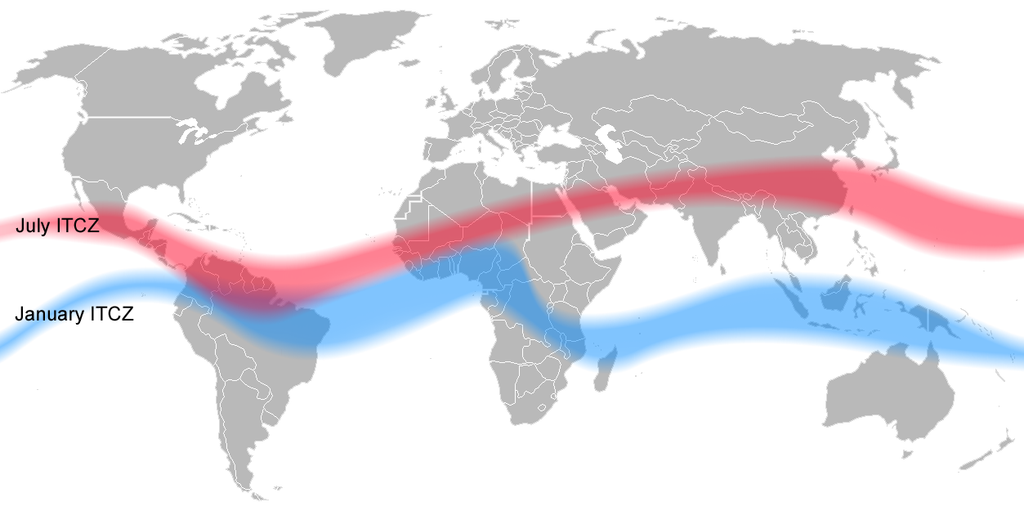
the light blue shows the ITCZ that we had to cross. (Mats Halldin [Public domain])

The ITCZ is also known as the Doldrums. It is the area where the northern weather meets the southern weather and, as they don’t mix, are characterised by calm or squalls, rain and cloud. They spread from West to East across the oceans apparently baring the way to sailing vessels. “The Book” suggests that you just take lots of diesel and when you find yourself becalmed turn south and turn the engine on. Friends did just that last week and motored for thirty six hours non-stop.

Information_Sign“The Book” is Cornells Ocean Atlas and the accompanying World Cruising Routes, both by Jimmy Cornell. They have diagrams explaining the average weather in each month and descriptions of the best time and tactics to sail the various routes.

But we are sailors and we barely carry enough fuel for thirty six hours of motoring. We had a different plan. We waited for a strong period of north wind and let that carry us as far south as it would. In February (on average) there is a “gap” that opens off the coast of Columbia and Ecuador which we aimed to squeeze through. 

The Parasailor effect. Speed dropped to under three knots and sail flogging. Hoisted Parasailor and moving twice as fast.

And it almost worked. We averaged over five knots for three days before eventually running out of wind while still two and a half degrees north of the Equator. Luckily we have a Parasailor so we flew that and it kept us moving (barely) for another fifty miles. Just before dawn we hit the promised deluge. No wind, choppy seas and buckets of water. Perfect conditions to go up on the foredeck and strike the Parasailor.

We bobbed around with just the jib up and drifted back North. Eventually we felt the hint of a wind and managed to turn the sluggish boat and move at about one knot heading south east. Sometimes we nearly managed two knots hand steering through the gloom in the downpour.

After a few hours we picked up the winds of the South Pacific and the rain stopped. As we sailed south the wind speed increased and with full sails we headed for Ecuador. It looked like we had found the secret doorway to the South.
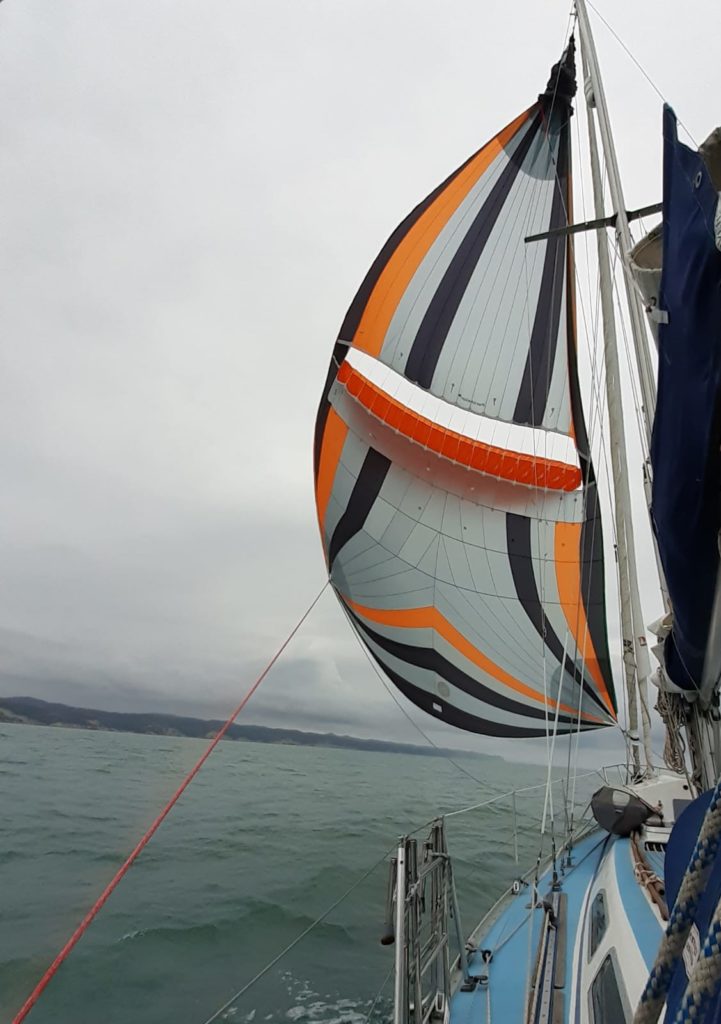
Parasailing to Ecuador

While friends further out in the ocean battled a southerly gale we enjoyed sailing hard on a south westerly wind which took us straight to Ecuador – unfortunately a little too far north so we could practice our tacking.

We finally reached the entrance to the river at midday on the sixth day. We crossed the equator the previous night so were now showing degrees south on the GPS. We had to wait until one hour before high tide to follow a harbour pilot across the bar and even with him leading it was interesting as we surfed big swell towards the town wall. 
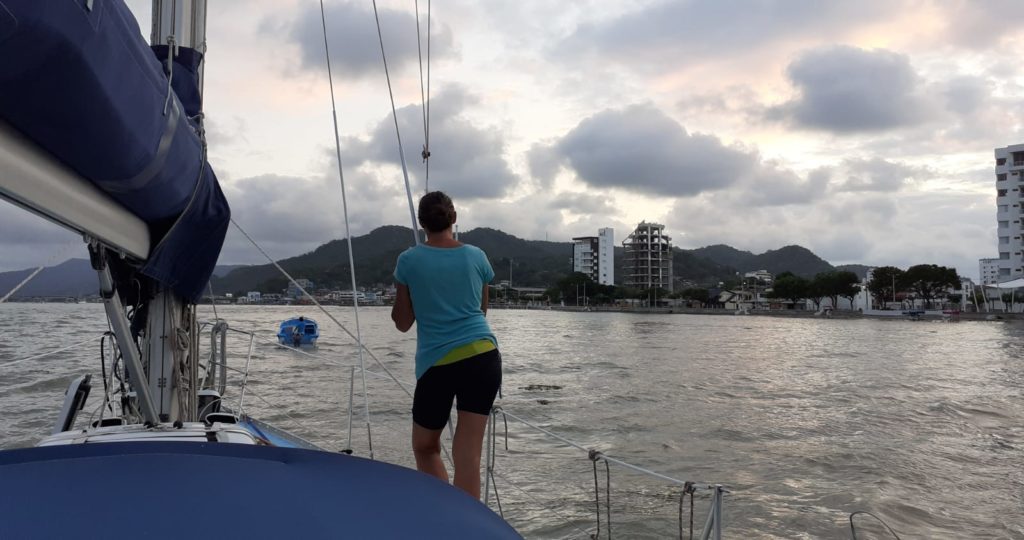
Heidi in contact with our pilot via sign language. She can sign fluently in Spanish.

And then, after six and a half days, we sat in the cockpit and looked at the Ecuadorian town of Bahia de Caraquez around us.


Sailing Days

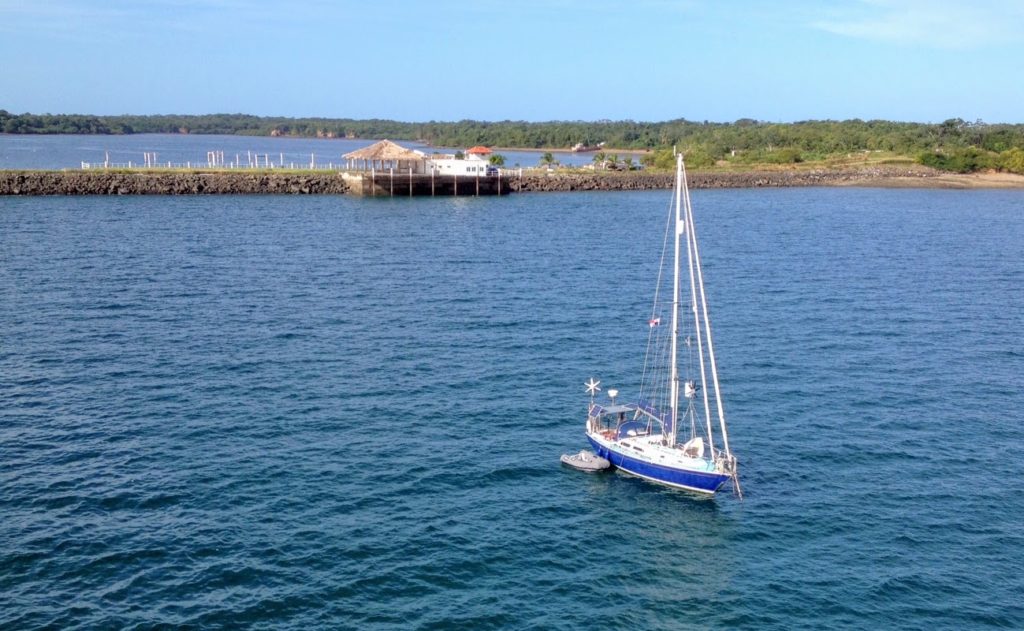
After three months in Panama we knew our way round, understood the bus system and knew which islands had the best Internet in which bay. It was definitely time to leave. Our start was delayed by serious stomach bugs and then we had to clear out with the harbour captain and a clown wearing an immigration uniform and a straw hat, but finally we got away.

Leaving Panama.

The wind was against us but we can sail up wind. What hindered our sailing was a police boat that intercepted us and gesticulated that we were to strike all sails and motor across the Canal entry channel. We were no faster with the motor and the nearest ship was far away so it made no sense but we complied until we reached the other side. A little later the wind died completely and we had to once again use the motor to stop us drifting on to the rocks of Isla Uraba.

By lunchtime Heidi had the boat clean and tidy, the fresh baked bread was finished and delicious and the home made yogurt was cooling. The first fresh water had been produced and everything was stowed to stop any rattling. We were lieing in the cockpit waiting for the wind. We read of people who take a few days to get in to passage making mode. It takes us a few hours.

In the evening we tried a new recipe. There was lots of cutting for Neill and lots of “magic” to be done by Heidi so it was a team event to create “downwind potatoes” – another delicious item for the menu at Restaurant Artemis.

During the first night we crossed a busy shipping lane. There were huge dark shadows passing in both directions in the moonlight, their presence signalled by navigation lights. We sailed between them feeling like a hedgehog crossing the motorway. The next day we were eating lunch when we spotted a Chinese freighter heading straight for us. A quick “panic jibe” and we watched him slide past rather than over us.

Either on the second or third day – no idea, at sea we are timeless – we were sailing downwind heading south. It was a sunny warm afternoon. All the days jobs were finished and Heidi was asleep in the cockpit preparing for the night shift. Suddenly, without any warning, an extra large wave dumped a ton of water over the stern. It drenched Heidi and knocked her to the floor (and thus in to the water) and then continued on through the companionway to soak galley, cooker, cupboards, battery boxes and everything in wet, sticky, salty water. First we cleaned the boat and then the Heidi.

Life is never boring at sea!

Provisioning

Long ago I was in the Falkland Islands and was amazed that, out on the farms, they had to buy all they needed for the next six months the twice a year that the supply ship came. I often went shopping twice a day because at lunchtime I wasn’t sure what I needed for dinner.

In Scotland Heidi patiently taught me that we could keep a few weeks supplies on board and thus increase our freedom to visit remote islands. In Kyle of Lochalsh the supermarket was next to the dock and for the first time we filled two shopping trolleys. 

in Martinique the supermarket has a dinghy dock.

In Tenerife we discovered home delivery and filled lots of trolleys for the Atlantic crossing. Since Martinique we always stock up with enough for the next three months. With full food lockers and a water maker, we are free to stay where ever we wish.

We now have an extensive list of all that we need so the “basic” provisioning is done just by ensuring we have everything listed. This is easy and allows me to be useful and collect items just by consulting the spreadsheet. It leaves plenty of time to search for new interesting items to try and maybe add for next time.

For Heidi it has also been a learning process. As a farmers daughter, she was unaware that you could buy meat in tins nor cheese in bottles and she had never used powdered milk. But she has learned to cook without a cow in the barn or a butcher’s down the road.

When we find fresh food at a sensible price we buy some, but it is good to know that we can create a pizza or a lasagna even after a month without seeing a shop. Often village shops only have a very limited choice but you need to remain flexible. If they don’t have potato we buy yam and if they cut a bucket of lemons off a tree then you create a new lemon drink.

With good planning followed by a dose of flexibility we eat healthy, enjoyable meals and are getting closer to the six months of  provisioning I remember from the Falklands.

Panama

Panama – a place I knew from a children’s book, a palindrome and as the place we were going to cross from the Atlantic to the Pacific. I assumed we would turn up at the north end of the canal, lock through and then head on west. I definitely didn’t imagine spending three months here. But that is sailing – always different to your plans.

We arrived in the backwater of Linton Bay where we cleared in and then picked up Annalena & Daniel for a two week holiday among the palm islands and coral reefs of the San Blas Islands.

Panama was also the land where we bought a new dinghy (thanks to Sheila) and finally achieved a working water maker (thanks to Felipe).

The next stage was the transit of the canal. There has been so much written about this and all the potential problems, that we were a little surprised how easy it all was. The most challenging task was sleeping five people and feeding six. Once the last gate opened and we motored out in to the Pacific we really felt that we had passed “the point of no return.”

Panama City skyline – the view from our cockpit

Anchored off a big city is not that much fun so we headed off to the Las Perlas archipelago for a week and ended up staying a month. It really is that sort of place. Days at a time we saw no one and mostly were anchored alone in a bay surrounded by jungle. Our friends on Bengt turned up for Heidi’s birthday and Christmas. A beautiful month.

We returned to Panama City, went in to “work, work mode” and installed additional solar panels, new batteries and a new solar charger. Repaired a wind generator and bridged the broken gas alarm. Resealed a variety of leaking deck fittings and modified our bimini. Polished stainless steel and oiled teak. We also designed and sewed a utensil holder that cleverly uses a hidden space. We were finished just after sunset two days before our next guests arrived.

anchored alone off the Las Perlas Islands

Caro and Stefano had no sooner set foot on Artemis than we upped anchor and set off back to the Las Perlas Archipelago for a two week “best of” tour. Stefano has his practical skippers exam booked for April so Neill took a back seat and let him do all the planning and sailing. With four hard working, motivated people on board, we sailed almost every day but it was completely stress free and a holiday for all of us. Stefano really had to “show what he was made of” on the last day when Neill was ill with stomach pains and he, Heidi & Caro had to take the boat back against the wind to Panama City. We are convinced the skippers exam will be easy for him – especially as there are no four meter tides in Croatia and no shipping lanes.

The ladies anchoring at sunset after Capitano Stefano fought the counter current all day

Back in Panama City for the third time we finished off our list of open jobs, provisioned as much as the lockers will hold and now plan on clearing out tomorrow and sailing away.

San Blas Inseln (Annalena)

Annalena & Daniel in Panama

Hier ein Bericht von Annalena die zwölf Tage, gemeinsam mit ihre Freund Daniel bei uns am Bord war.

Am 28. Oktober ging endlich unsere Reise zum Segeln in die Karibik nach Panama los. Daniel und ich flogen von München nach Panama City. Dort landeten wir um halb 8 abends, woraufhin Vidal (unser Taxifahrer) mit einem Bild von Daniel auf uns wartete. Daraufhin gab es eine abenteuerliche Fahrt durch den Dschungel, die ich komplett verschlafen hatte. Angekommen in der Marine in Port Linton suchten wir das Segelboot von Neill und Heidi, das mit dem Namen Artemis getauft ist.

Continue reading “San Blas Inseln (Annalena)”

Christmas away from “it all”

It is not a great secret that in the “real world” I dislike Christmas intensely. I hate Christmas trees, dried up turkey and crackers. I cringe at the thought of a whole month of “driving home for Christmas” and “last Christmas” on the radio and I am deeply saddened by the misery that the commercialization brings. When my son – a policeman – wrote of being called to a suicide and then a domestic argument on Christmas Eve, that just confirmed all my prejudices.

Last year we avoided Christmas completely as we were at sea two hundred miles off the Sahara.

This year we spent the days anchored off Isla Canas in the Las Perlas archipelago. On Christmas Eve we joined our friends Elizabeth and Wim on a dinghy expedition up river to the cataracts at the river head. We had been told of these falls but had no accurate information where they were. We followed the largest river and got lucky. Lying in shady fresh water pools and eating chocolate brownies on a large rock in the middle of the jungle was definitely a dream outing. Back at the anchorage there was a waterfall on the beach so we could shower intensely before dessert and drinks on the yacht Bengt.

Bengt and Artemis anchored together off Isla Canas

In the tiny and immaculately clean village across the bay we bought fresh fruit and vegetables. All the fruit was “cut to order” in the neighboring jungle while we waited at the store. We received a whole bucket of lemons so Heidi had to invent a new drink with lots of lemon, sugar and rum – “Canasitas”. Suggested dose if you need to walk or row: one!

On Christmas Day we read, swam, showered again and enjoyed the quiet. The only presents we gave or received was three liters of fresh water that a young family passing in their boat asked for and some sweets we gave their children.

I really enjoyed this Christmas.

Las Perlas Archipelago

Three weeks ago we sailed to the Las Perlas archipelago off the Pacific coast of Panama. After transiting the Panama Canal and spending a week anchored off the city, we just wanted to “get away” and find some lonely corner of the ocean.

We sailed through the night and before sunrise were off the Isla Pedro Gonzales. We anchored in a bay well protected from winds from all directions. We dinghied to a pontoon and were firmly but politely told that everything except the village is private and sent on our way. We visited the only village and bought a dinghy full of fruit straight out of the jungle. Originally the seller literally filled our tender with more fruit than we could ever eat. We laughingly explained that there are only two of us and took most of the produce back out. That night we visited the private marina and drank an amazing Mohito in the bar – which was open just for us; the only guests. It was depressing to compare the poor village with the luxury just across the bay but a world apart.

taking the dinghy upriver looking for waterfalls

Next we sailed further south to the (also private) island of Isla San Jose. We anchored off a long sandy beach and saw almost nobody for four days. One day we rowed to the beach and waved to four locals on a neighbouring hill just to prove our social skills are still functioning. Trying to get back off the beach through the waves was challenging and ended with a dinghy full of sea.

Heading back north, we threaded through the hidden reefs and rocks to anchor in a tiny bay off Isla Bayoneta. At low tide we took the dinghy through a channel between the islands and plotted a safe route through the rocks. At one point we only had twenty centimeters below us. When we reached the anchorage beyond the channel we saw a familiar looking catamaran with a Brittany flag and were invited for coffee by Marc and Sylvie on Iroise who we know from the Canal transit. Later, at high tide, we took Artemis along the same route with a comfortable two and a half meters of water.

Our next stop was off Isla Viveros. Here developers have built roads and laid electricity to each plot so that rich people can build nice holiday houses. There are a few houses but overall an air of decay. It looks like another great idea that isn’t working. At least there is a functioning beach club and the day before Heidi’s birthday the swedish boat Bengt appeared with our friends Elizabeth and Wim on-board. The result was a long birthday lunch (with a few drinks) followed by Curry (and more drinks) on board Artemis.

River scenery

We traveled to Isla del Rey and anchored off the small township of San Miguel. The plan was to find some jungle trails for the mountain bikes. On foot, we followed the only track out of town and in to a dense tunnel of foliage. It looked promising but less than a kilometer later it stopped at the towns airstrip. Here there are no trails; everyone travels by boat. On the way back we stocked up with fresh fruit and a few other essentials – as well as a six pack of Coke which cost as much as everything else together.

Another few miles along the coast and we found cruisers paradise. A well protected anchorage behind the island of Isla del Espiritu Santo. No swell from any direction. Jungle in all directions. Beaches and even a fresh water stream. Pelicans, fishing bats at night, jumping fish and even a dolphin. Bengt is anchored nearby and we are definitely “away from it all”.

Water, water, everywhere …

The pilot books write that fresh water streams enter the sea here off Isla del Rey. An old, hand drawn map even shows one of them but we couldn’t reach it through the magroves. Neighbours on a german boat had been here many years ago and knew the location of an easy to reach stream up a long inlet. Yesterday morning, just before high tide, a convoy of three dinghys headed off across the bay loaded with washing and empty water canisters.

Information_SignWe have different “qualities” of water that we use. Sea water is great for the first clean; be it cleaning of boat, kitchen utensils, lines or people. And it is limitless. Stream water we also use for cleaning. Marina water is drinkable but mostly tastes of chlorine. Still good for coffees, cooking and everyday use. Rainwater is pure away from the cities and after the first run off goes in to the main tank. The Katadyn water maker produces pure water that we drink and the excess we also add to the tank.

The stream is really well hidden but, with our “guide” leading the way, we found it easily. A few right angle bends through the mangroves and we tied up at the streams outlet. A little boulder hopping took us to some pools surrounded by flat rocks under the shade of the jungle canopy. There was no sign of crocodiles and the six of us were loud enough to warn the biggest snakes that we were there so we could wash our clothes and seat covers in peace.

In the Las Perlas fresh water is a luxury.

We filled five containers with water destined to be used to clean Artemis and then did some serious showering revelling in the absolute luxury of limitless fresh water and the coolness below the dense foliage.

Today we planned an early start and boat cleaning with our five canisters of water. And then it rained. Within minutes we were being lashed by wind driven rain. Heidi shot out of bed and started to collect rainwater for our fresh water tank. When the wind rose such that the water was coming horizontally, she grabbed a scrubbing brush and motivated Neill to help clean the entire deck and cockpit with the never ending rain. The dinghy was swimming in water so all the lines (ropes) and strops we own were uncoiled and thrown in to the “floating washing machine”. We changed between cleaning and collecting water depending on the angle of the rain but by midday the tank was filled to seventy percent, Artemis was shining and …

… the canisters of stream water are still full and looking for a new use.

Ultra Stereo 98.9FM – Panama

We are anchored off Viveros Island in the Las Perlas archipeligo. We have been “lost” among these pacific islands for nearly two weeks now. Uninhabited islands, reefs and deep water passages between all the rock. Jumping fish, Rays swimming in formation under the boat and pelicans flying above us. Sunshine, breezes and a huge full moon at night. We have reached paradise.

Artemis at anchor amongst the islands

Two days ago the Swedish sailing yacht Bengt sailed in to the bay and yesterday we celebrated Heidi’s birthday at the beach club on the island followed by dinner on Artemis. Life is good.

Today we tuned the radio in to the Panamanian radio station Ultra Stereo 98.9FM to enjoy non-stop music from the 80s. Just after sunset they played ” a whole lotta Rosie” by AC/DC.

So there I was with the radio turned up full and singing
“Wanna tell you story 
About woman I know 
When it comes to lovin’ 
She steals the show…”

at the top of my voice to my bikini clad beauty.

birthday girl in video chat

I think, if 19 year old me could have seen 56 year old me he would have approved.

Dinghys

The perfect cruiser’s dinghy packs up really small and can be stowed away for passages. At the same time it should be stable in use and capable of carrying people and cargo safely and relatively dryly.

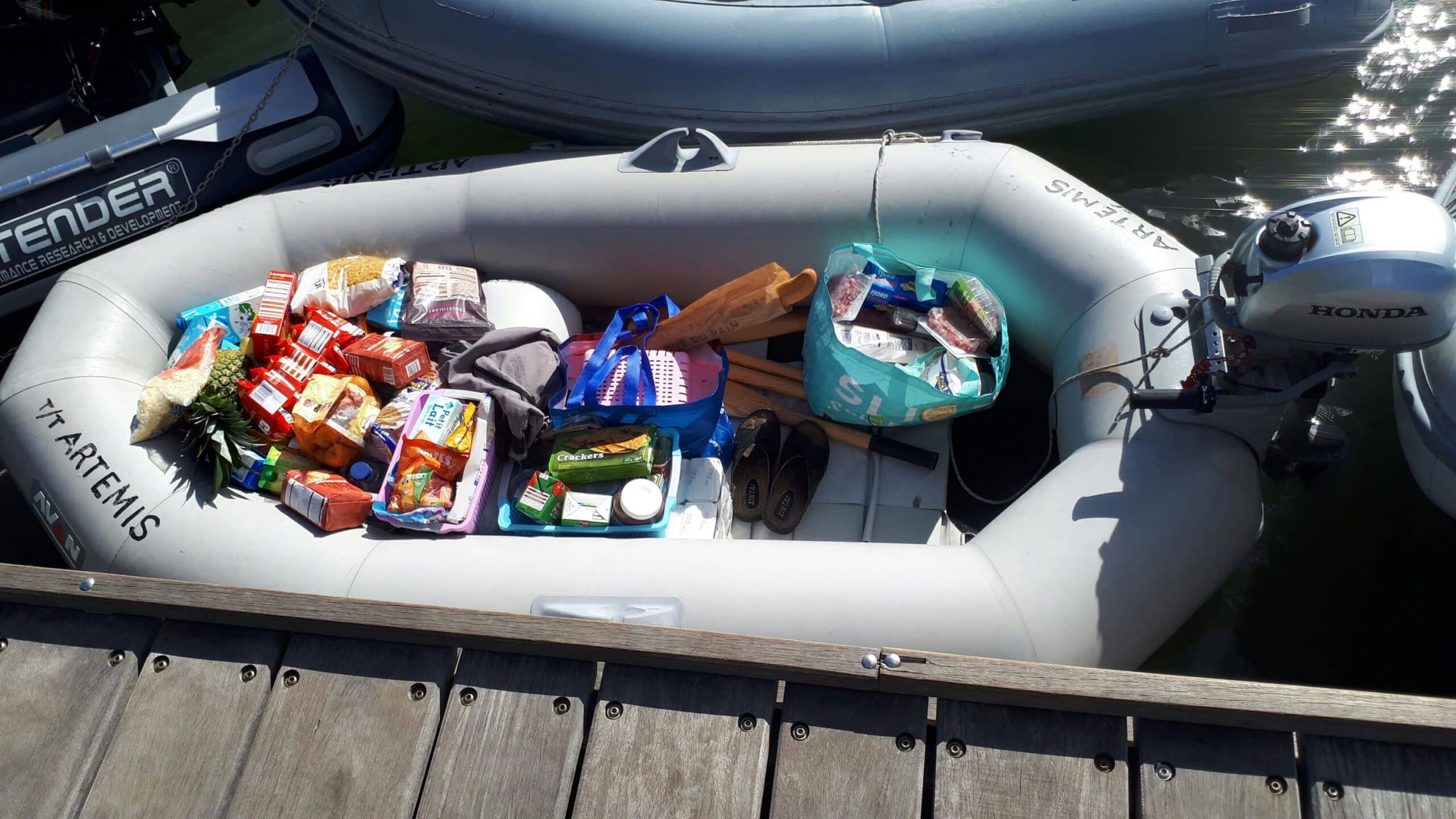
Our inflatable Avon fulfils the first specification perfectly. It takes a little time to install the wooden slat floor and rowing seat then blow it up and just as long to reverse the process but it stows in the aft locker. Unfortunately it fails on the safe and dry requirement. If we use it to go up wind against waves of any size, the only suitable apparel is bathing clothes and everything we take needs to be extremely well packed. More than once it turned over in the wind and once set the outboard under water. When we visit another boat, we need to remove the motor and hang it on their boat if we want to relax.

Our Avon dinghy fully stocked

In the Caribbean the Avon was ripped directly next to a seam. Four attempts by us to repair it all failed and when we found an expert in Panama, he could only solve the problem by lifting part of the seam and glueing under it. His repair worked but we needed a more reliable tender.

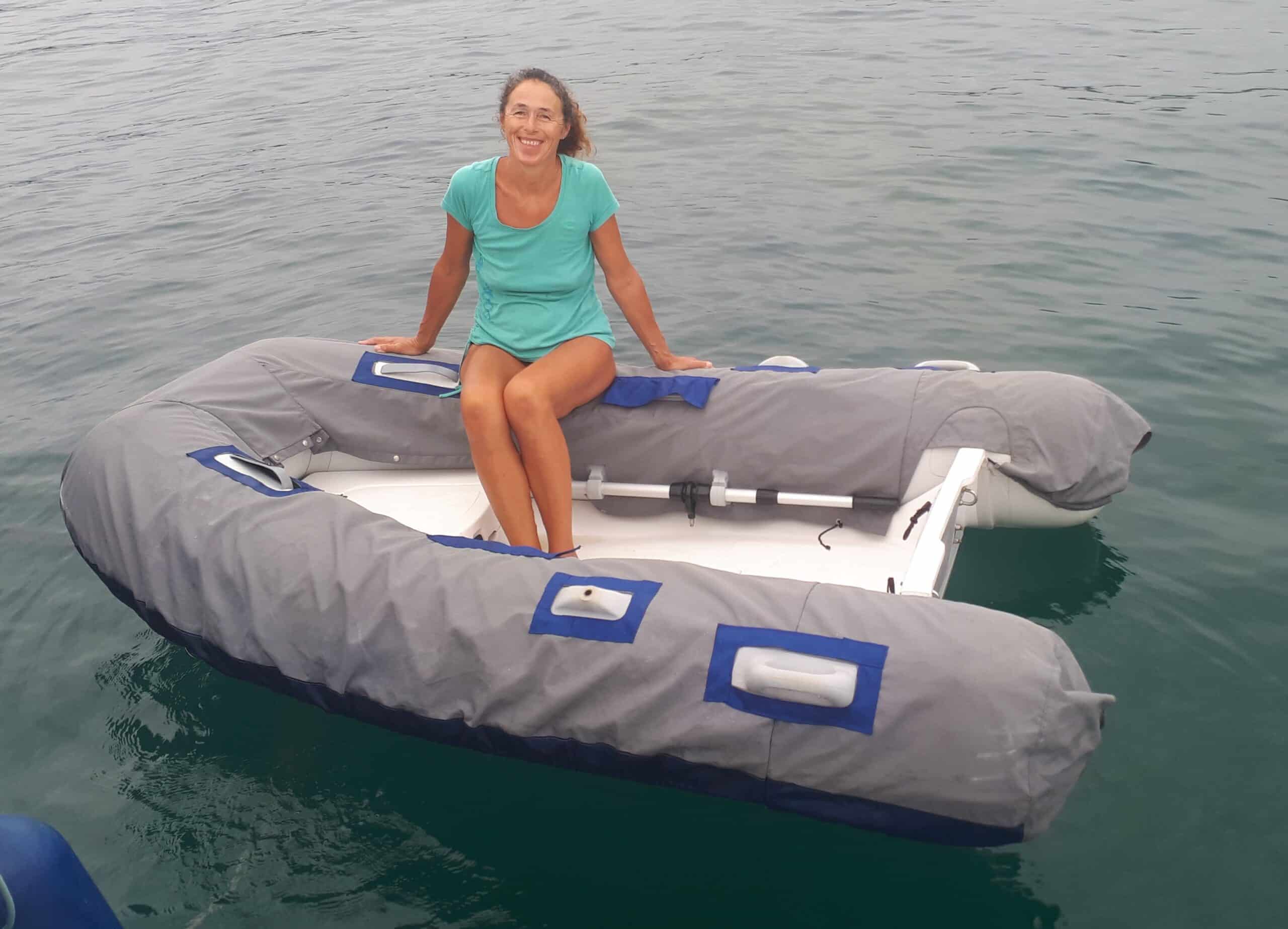
The selection of small dinghys in Panama is not huge but with the help of Sheila (an American lady rebuliding her boat at Port Linton) we bought an AB dinghy with a fiberglass bottom. This is safe and stable but impossible to stow any where but between the mast and inner forestay. Sailing is, of course, a series of compromises so we have now developed a way of doing that. Once we have the AB dinghy in the water she is great fun. We bought her just before Annalena and Daniel arrived and “test drove” extensively in the San Blas Islands. In the Las Perlas archipeligo we completely filled her with water when a breaker swamped us just off the beach but, even full of water and sand, she can be rowed home.

With the dinghy, we received a free dinghy chap (a material cover to protect the dinghy from sun and rubbing). It was for a different size and type of dinghy and had no holes for the carrying handles or anything but did come with a bag of “blue bits” to sew as protection around any holes. Luckily we have a Heidi on board and she and her sewing machine can do anything. After hours and days of hard work, perspiration and many many broken needles, we had a cover that fitted and a matching bag to stow items while in transit.

Another sailor told us he had been quoted one thousand US dollars for such a dinghy chap and Heidi now says she fully understands why they cost so much. She doesn’t plan a production series.