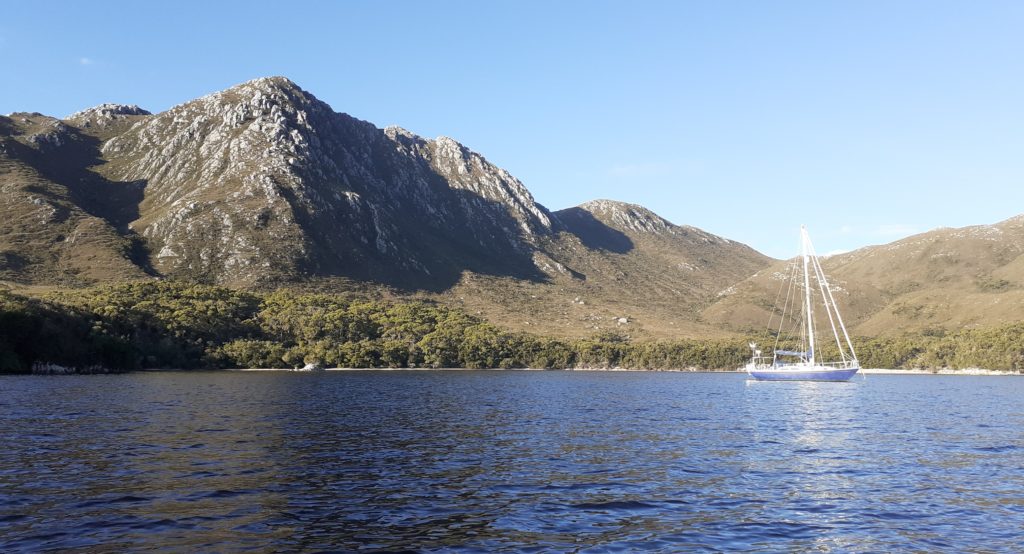
We are alone anchored in Bramble Cove in the south west of Tasmania and directly behind and above us is an imposing five hundred meter high mountain of craggy white rock. Our map says its name is Mount Stokes but the marine charts talk of Mount Misery. The pilot book can not decide and shows both. The aborigines certainly used another name before their eradication. It is irrelevant what it is really named, it is impressive under any name.
Imagine it is a warm dry day in late autumn and there is a beautiful mountain offering panoramic views across an island speckled ocean, a landscape of inlets and bays, and never ending mountain ridges. Imagine that a tiny, steep, overgrown path leads from a lonely beach to the rocky summit. And now imagine that the entire day this mountain is climbed by only two people. And imagine that from the summit there are no villages, no houses and not even a wall to be seen. No sign of civilisation impinges on the majestic view except the tiny sailing boat that the two call home, anchored almost five hundred meters below them.
And just when we thought it couldn’t get more remote …
We had heard that up the Davey River there were impressive gorges where the river cuts through bands of hard mountain rock. We had also heard that they were reachable by dinghy.
We sailed across the swelly waters of Port Davey making use of the winds blowing up from Antarctica. We then gingerly nosed Artemis across a shallow bar and anchored in a deep pool with a little protection from a woody peninsular. We used the strong wind to pull the anchor hard in to the sandy bottom and then waited a night to be sure the boat was really safe.
The next morning we awoke to sunshine, no wind and the promise of temperatures above twelve Celsius. We had agreed to explore the river the same day as the crews of two other boats for safety and so awaited their arrival. Once they appeared and anchored, we packed the essentials in to the dinghy, wrapped ourselves up and set off across the sea towards the river while keeping a sharp watch out for the multitude of kelp covered rocks lurking in the dark waters below us.
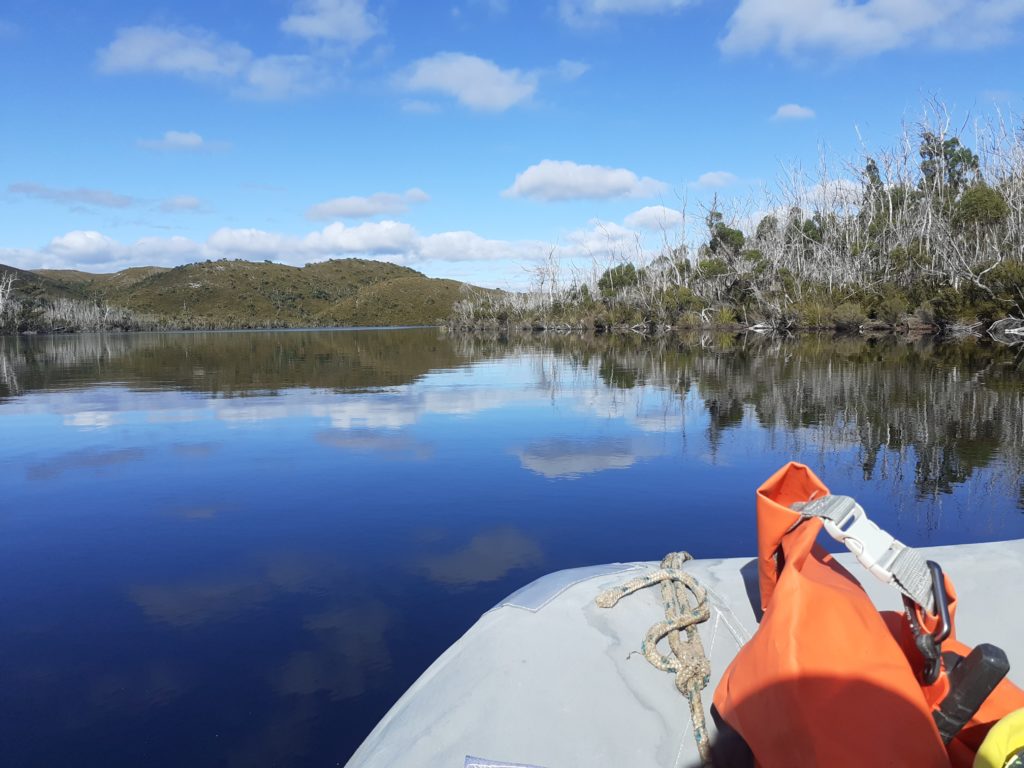
The river mouth has a shallow sand bar and we crossed at low tide, surfing the small breakers to pass from ocean to river. The other dinghys were now far ahead of us so we followed the meandering river towards the mountains. Just the two of us, a dinghy, an outboard, a flask of coffee and a packet of biscuits. The nearest inhabitation was hundreds of kilometers away, there was not a single sign of humans and we did not even see an animal the entire journey.
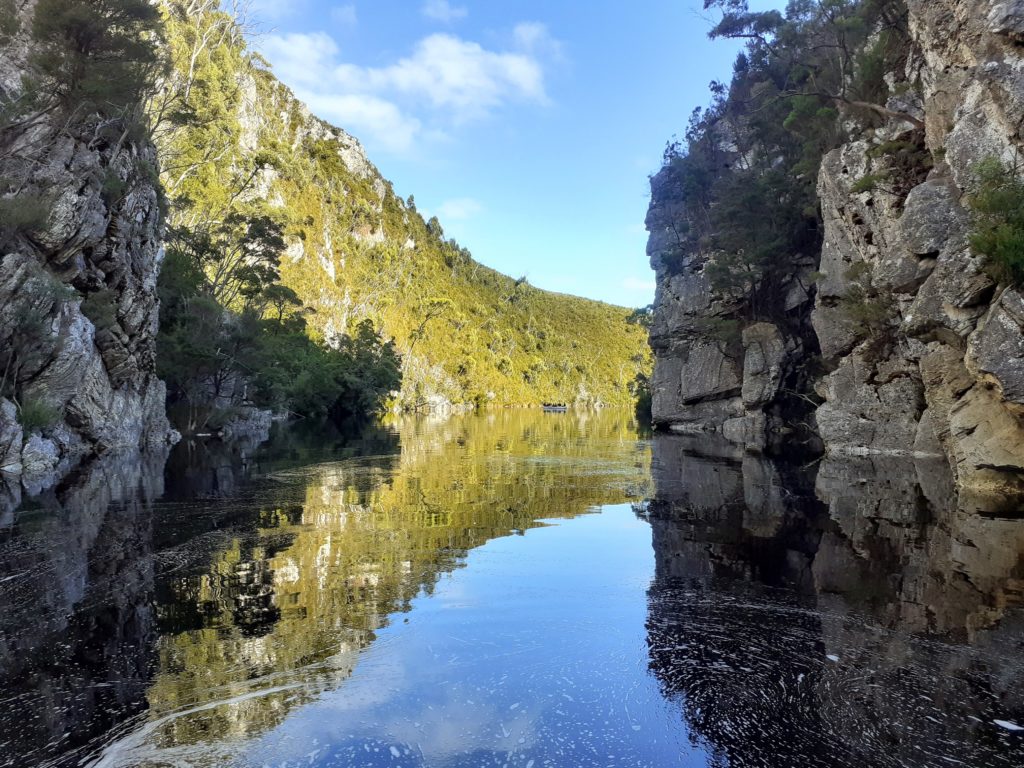
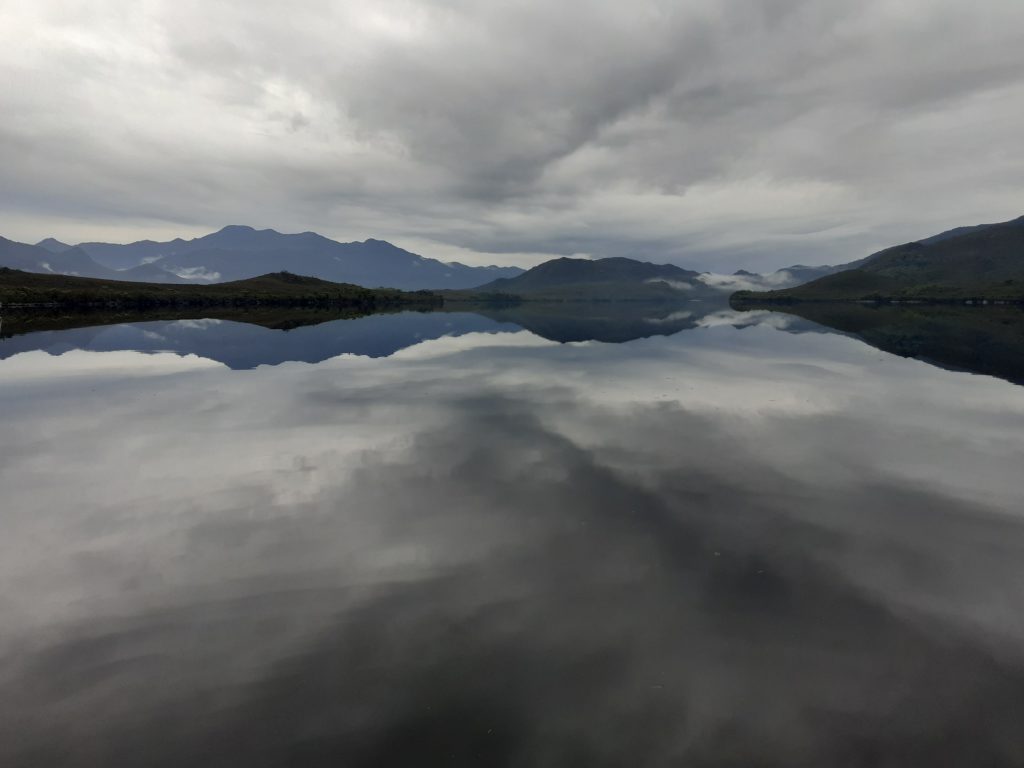
After about sixteen kilometers we reached the point where the river entered the mountains and continued in to the deep gorge. On both sides the cliffs drop vertically in to the black river which reflects them perfectly. We passed the other crews drifting down river but continued on up as far as the dinghy could safely reach. The whirlpools on the surface now promised many submarine, propeller eating rocks and the back of nowhere is not a good place to be “up a creek without an engine”. We turned the motor off and slipped slowly back down river with no sound but the running water. Anywhere else in the world we would have to share the experience with all the other people but here there were no others, here the whole gorge was reserved for the two of us.
With four hours of daylight to still play with we retraced our route at a leisurely pace. The current was now with us so we could run the outboard motor at less speed and enjoy the relative silence and the amazing sense of solitude as we passed virgin forest and untouched hills with everything reflecting in the river.
Nearly seven hours after leaving Artemis we were back home after another exciting adventure. As the sun set, we enjoyed a coffee in the cockpit and agreed that we “did it right” again.
The dream at the far end of the earth is Port Davey in the south west corner of Tasmania. It can be reached by a long foot march, light aircraft or boat. It is otherwise cut off from the world and uninhabited.
Get yourself to Australia with a boat then travel south for thousands of miles until, having braved the Bass Strait, you reach Tasmania. Continue south stopping off in Hobart then continue to Kettering and then the hard part starts.
We left Kettering to travel south along the d’Entrecasteaux Channel to Recherche Bay. The first day there was little wind but more than forecast and, with full sails set, we made it to The Quarries Bay on Bruny Island just before the sun set.
The second day there was more than enough wind and it was straight against us. We reefed the sails and tacked backwards and forwards up the channel. Heidi was calling the tacks to avoid fish farms, islands and reefs before finally navigaing us into Recherche Bay. We took a lot of water over the bow and were happy with the Bay’s shelter. It is billed as the most southerly all weather anchorage and has provided sailors with shelter for over three hundred years. Here, four boats were anchored waiting for the following day.
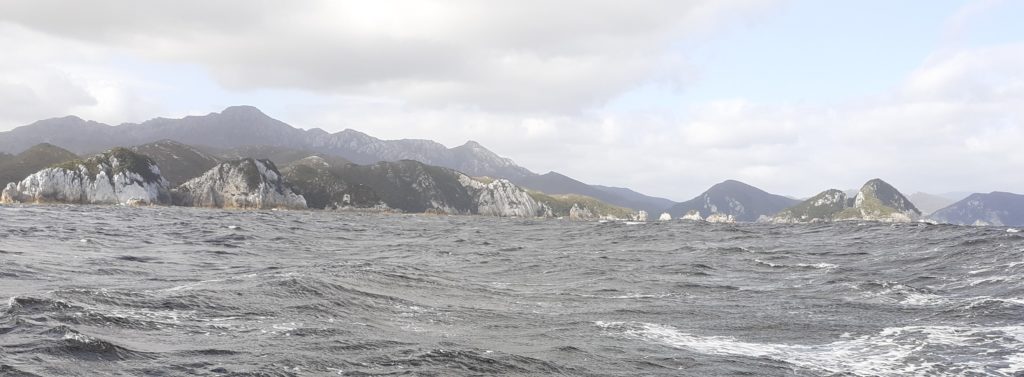
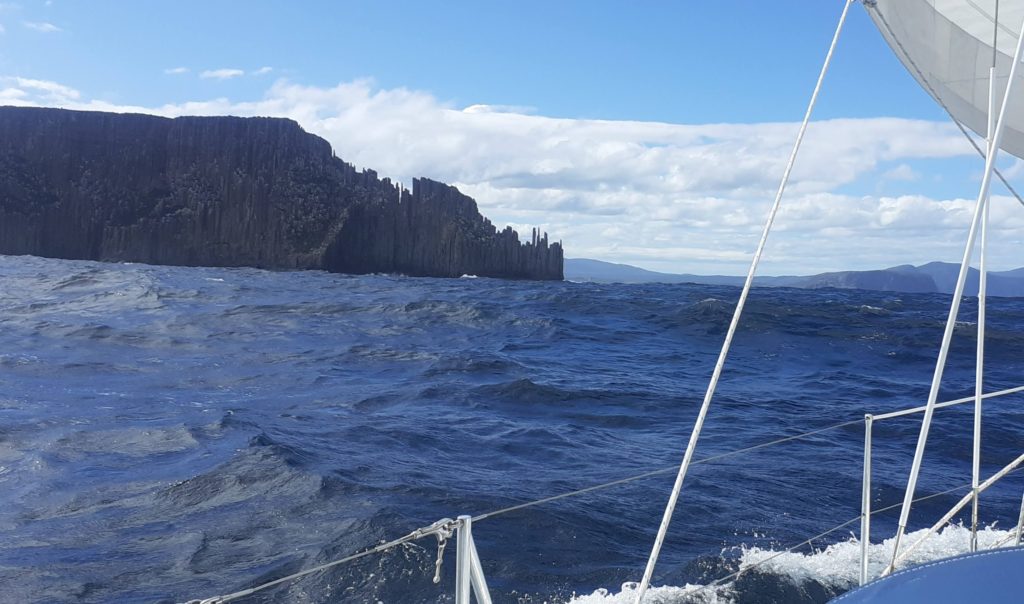
At dawn on the third day we headed back out to sea hoping to find the forecast east wind to blow us across the Southern Ocean under Tasmania. Most days this route is impassable but on this day there was one of the occasional lulls in the legendary gales of the Roaring Forties. We rounded Tasmania’s south east corner and were met by the long three meter high swells that work their way up from Antarctica before committing suicide next to us on the cliffs and Islands that litter this area.
The wind did not appear for twelve hours. Normally we would wait but here that is not an option as violent southerly winds were forecast for the following day. We motored past massive islands, imposing capes and strange rock formations. Dolphins and seals joined us at various times and once we even had a pack of dolphins which included two seals showing off that they could jump just as well. One dolphin twice jumped through the rainbow of spray to our side and briefly became a multicolored fantasy creature.
As the sun set we rounded the South West Cape and a breath of wind arrived so that we could finally turn the engine off and sail. I enjoyed the peace and slept while Heidi headed north. The wind lasted almost three hours after which she changed back to motor. When I awoke we were passing hulking rock islands in the light of the full moon. Indescribable!
We anchored by the light of the moon just after midnight and slept until rain and overcast light woke us.
The rain stopped and we sailed across Port Davey and in to the Bathurst Channel. Imagine virgin, untouched hills and soaring craggy mountains with a waterway that threads through them devoid of evidence of mankind. Add areas of natural forest, wooded Islands and stunning reflections. Add wreaths of cloud across the mountains and silence. Here it is all of that but so much more. We passed into the core of this area in wonder and dropped anchor surrounded by unbelievable beauty.
In 1792 Rear Admiral Antoine Raymond Joseph de Bruni, chevalier d’Entrecasteaux sailed to Australia and explored southern Tasmania. In recognition of his achievements an island was named Bruni Island. This name was too complicated for the locals so, in 1918, they changed the name to Bruny Island. They called the channel that separates the island from the mainland the D’Entrecasteaux Channel and strangely they can pronounce that.
We left Kettering to sail around the island and began by sailing across the channel and anchoring in the lonely and quiet Alexanders Bay. We were totally alone until we were hailed by Lucie and Paul from Pittwater who had just escaped from three weeks trapped by awful weather in Port Davy. They dropped anchor and, by the time they reached Artemis, we had a meal waiting for them. One thing led to another and it was a late but incredibly enjoyable evening.
Alexanders Bay
On day two we headed south directly in to the increasing wind. The waves grew constantly, driven by the wind and after a few hours we popped in to the Isthmus Bay and hid behind a forest. We continued the journey the following day to reach Southport on Tasmania. We anchored in well protected Deephole Bay and were soon joined by a second boat. Jo and Michael were locals taking a few days off to “get away from it all” on their boat. None the less they welcomed us on board for drinks and fed us quiche. They also pointed us to the abandoned railway in the forest and the walk across to the lagoon.
Cape raoul
The next leg took us back to Bruny, past the lighthouse and through a small rocky channel that offered great views of a seal colony but required precision navigation. Luckily Heidi is now an ace navigator. After the seals, we turned North and headed for Adventure Bay. I have written about the great bike ride and hospitality we received there in another post.
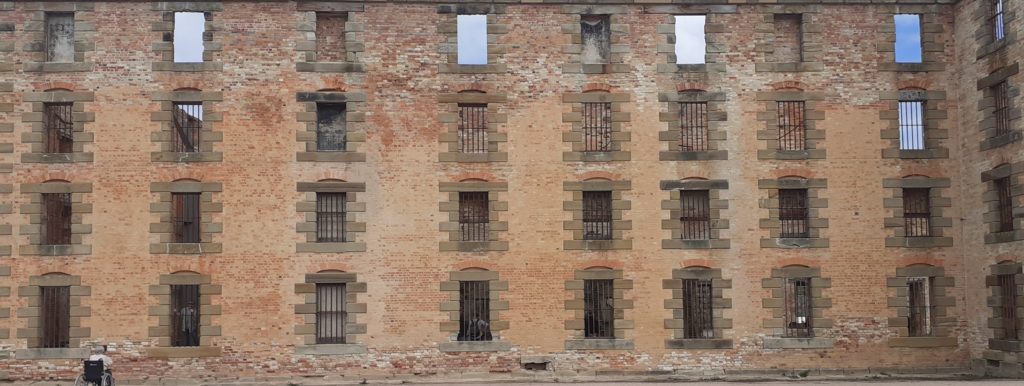
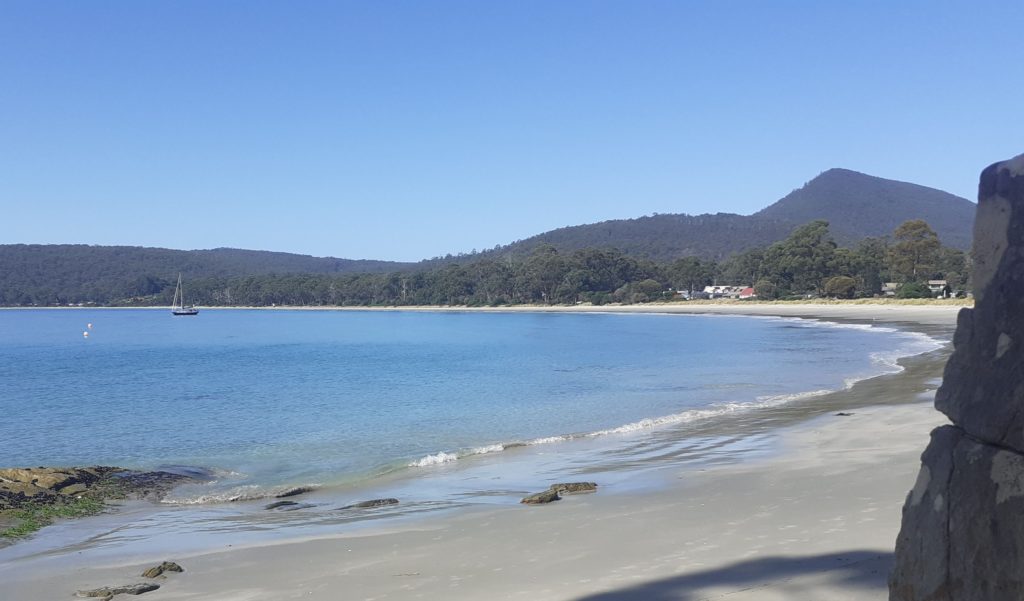
From Adventure Bay we crossed Storm Bay to reach the Tasman Peninsular where we anchored in Ladies Bay behind Frying Pan Point (honestly, we don’t invent these names). From here it was a short walk to the ex convict settlement at Port Arthur. This is not the first convict prison we have seen but definitely the most depressing. In other countries we have been faced with the history of the use of non European slaves. Here we could experience the barbaric story of the British enslavement of their own people.
Port Arthur
Once again there were two boats in the bay so three nights running there was drinking and fun conversation on the boats. On the third night Colin and Claire also fed us a delicious curry and invited us to visit them at their farm on Bruny Island.
After fourteen days, we today completed our circumnavigation with a forty mile sail back to the island through rain, mist and variable winds. Tonight we are anchored in Quarantine Bay and thinking of all the new friends we have made in the last two weeks.
In 1642 Abel Tasman first sighted Adventure Bay. In 1773 Captain Tobias Furneaux anchored here. In 1777 Captain Cook resupplied here and Captain Bligh followed him in 1788.
Adventure Bay 1777
And in 2023 Artemis arrived after nearly five years sailing from the west coast of Scotland. Some days you just feel the centuries of sailing that surround you.
We were lucky to meet Gill, a resident of Adventure Bay, on the shore. He and his wife Virginia let us store our bikes in their garden so this morning we only had to take the dinghy to shore and start pedalling.
and in 2023
Our route crossed to the far side of the island over the hills and through a huge forest. Heidi found a route that was rocky and steep but had the advantage of no traffic. There was just us and the wallabies.
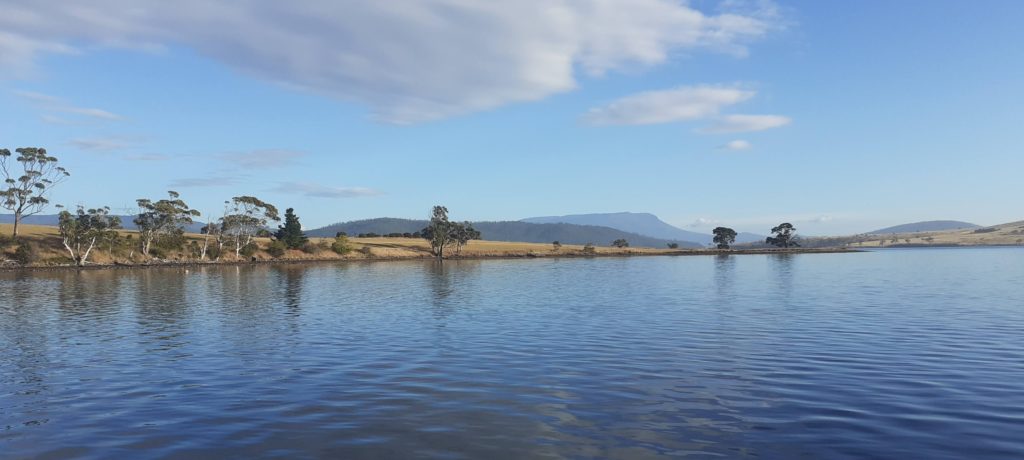
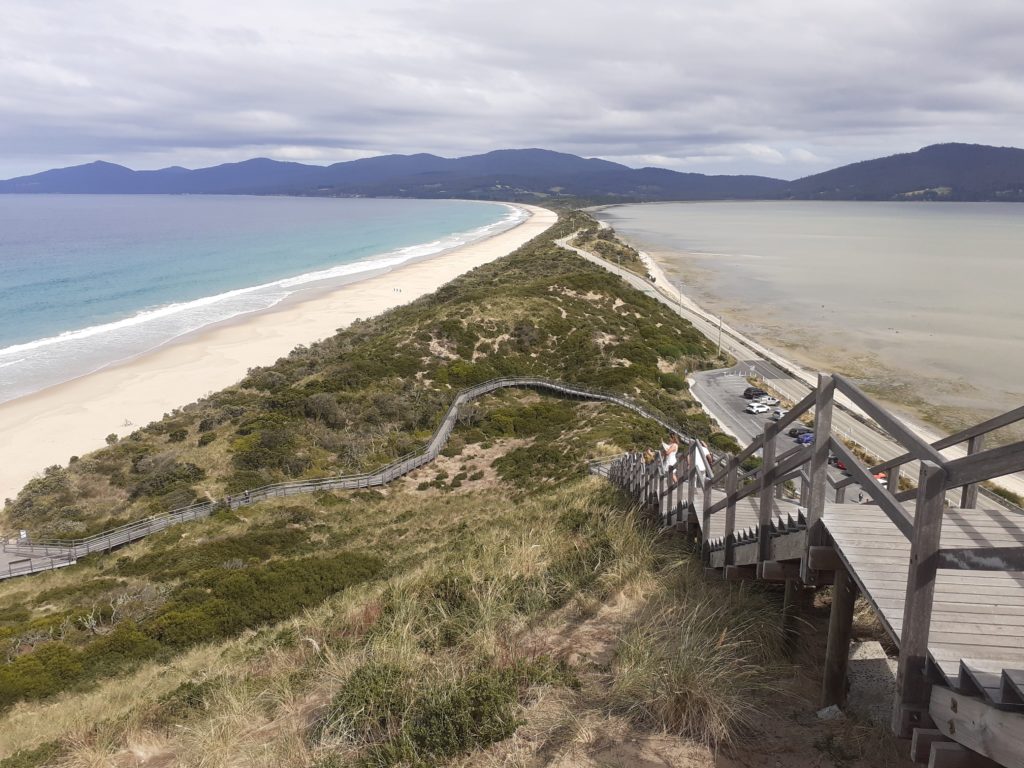
We continued around the island passing through the tiny settlements and then cycled out on to the neck – a long strip of sand that joins North & South Bruny Island. From a small hill, we had a stunning view of the islands and across to the mainland.
View along the neck and back to South Bruny Island
The journey back was along a winding road past historic sites and beaches and, for our 48 kilometers and 1000 meters of climbing, Virginia rewarded us with coffee and chocolate biscuits.
Sue & Chris were in Tasmania on holiday from Queensland so we considered fixing the tiny drip in the toilet before they came out sailing. However, being experienced sailors, we were pretty sure that a tiny drip could become a horror story so decided to wait a day.
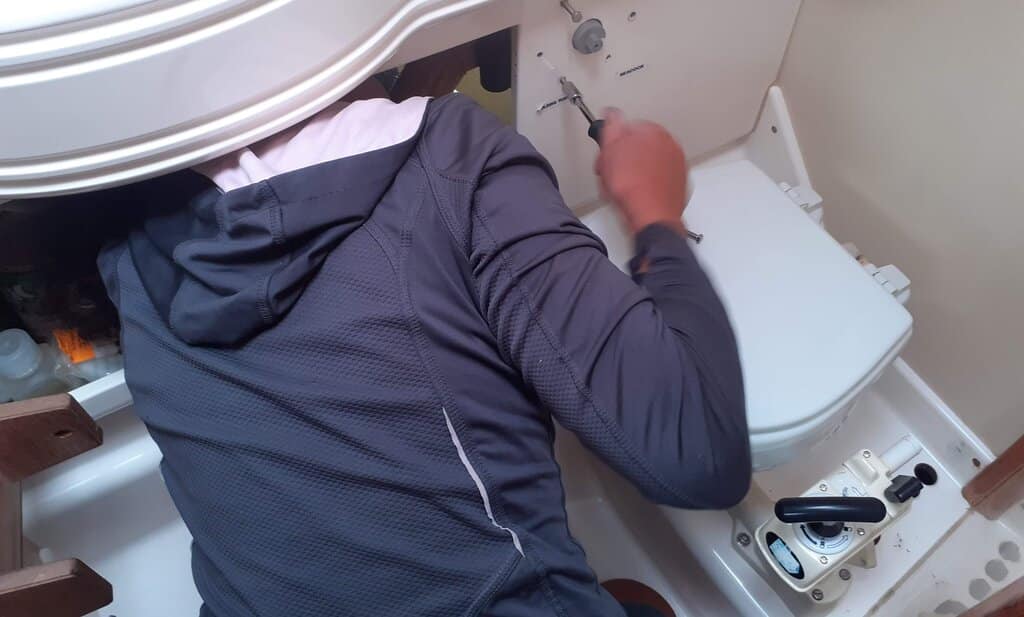
After a beautiful day sailing with our guests, we levered ourselves in to our tiny bathroom and searched for the leak. We rebuilt the entire pump unit but that did not help so decided it was due to back pressure in a blocked pipe. We pulled the main discharge pipe off and got soaked. It appeared that the valve that keeps the sea out was no longer working and we needed a new one. Remember that we mentioned horror stories in the previous paragraph!
To change a leaking valve you have to lift the whole boat out of the water and have someone who knows what they are doing. Luckily we had briefly met Jon – who was to become our “fairy godmother” – at the wooden boat festival in Hobart. We rang him and said “Help!” to which he answered “Ring Angelo and come to Kettering”. We rang Angelo who said “no problem” as Tasmanians do and then rang the marina for a lift out. The marina was fully booked but, when we said “Jon sent us”, a two hour gap appeared which Angelo said was “no problem”.
On the way to Kettering we stopped off at Bruny Island for three hours of wet, cold, foggy sailing with Janeil and Simon. Simon enjoyed the Tasmanian summer and spent all three hours at the tiller. After we anchored Janeil and Heidi thawed him out and he fell asleep.
On the appointed morning Jon came round to look at the problem and said “bugger-it, you can’t put a new valve in there. You have a Blake valve from England and nothing else will fit”. He cancelled Angelo and rang Bruce who built his own boat thirty years ago and included five Blake valves. Bruce came over and took a look and explained that the valve could be reground but the boat needed to come out for longer than two hours. Jon and I visited Emma in the marina office and they extended the two hours in the (full) marina to two days!
Once we were out of the water Bruce took a look at the dismantled valve and asked if we had a UK bank account as only a new Blakes valve was going to help and you don’t find them in Australia. So we are out of the water for a maximum of two days and need a valve from the UK. The horror story had happened as expected. But…
We were in Kettering. Bruce fished his spare Blake valve out of his boat (one of only two Blake valves available in Australia) and lent it us. Jon made a new teak spacer plate to fit under the valve and lent us the big tools we needed to get the old valve out. Alan lent us the “gunge”, spanners and paint we needed to complete the job. Bruce inspected and approved the new valve and we were back in the water as planned and the boat was waterproof.
The old hosing was ripped and bent at the ends so we bought some nice shiny new tubing and then wasted two days trying to get the f’*+?=ng stupid tubes on to the b/&%$rd fittings. Eventually Bruce advised that he had tried the white tube years ago and it was impossible to fit. Callum also told us that he and his son had given up with the §h”t white stuff. We changed to Plan B and used a combination of cut down old tube and new bendy stuff.
With everything rebuilt we checked the toilet and the pump still leaked! Horror Story Part 2. We ordered a new pumping unit to be flown in from the mainland and replaced old with new. After a few tries we finally had a non leaking toilet.
We pumped the toilet in to the holding tank and then tried to pump the tank empty. The pump-out wouldn’t pump and blew the fuse so we took it apart and ordered a service kit from the mainland. The serviced pump still would not work so we took it out and reinstalled it a few times. In the process we discovered that the original wiring and fuse was wrongly dimensioned so now we can fix that as well.
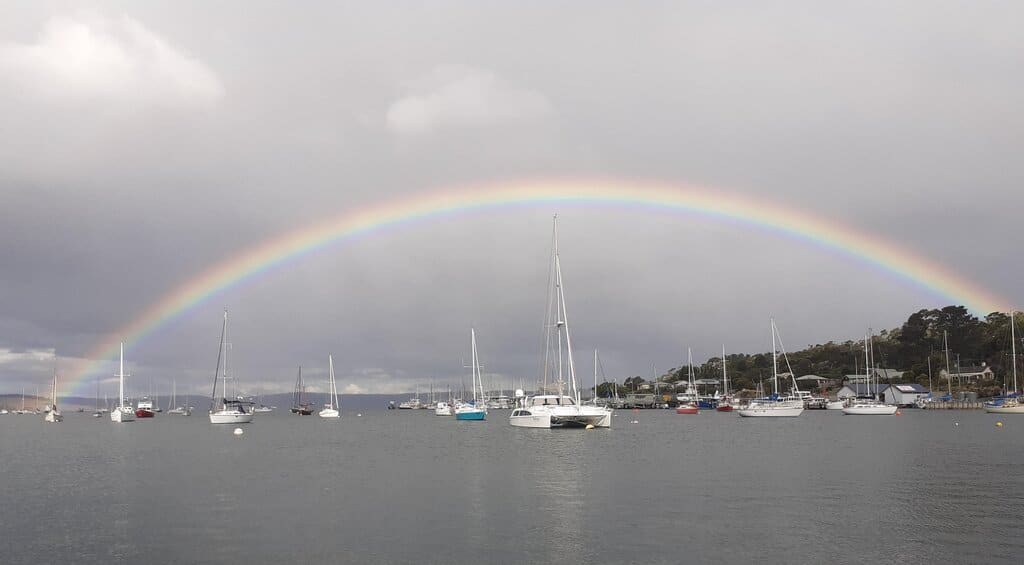
Somewhere under the rainbow
The above sounds like a bit of a disaster but there were compensations.
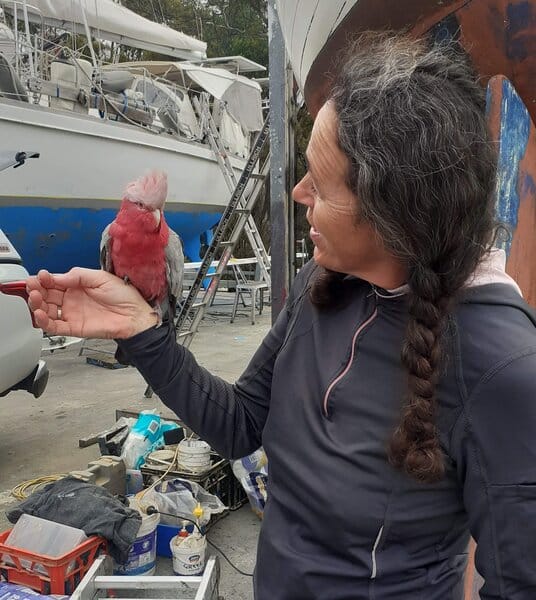
we were lent Callum’s carpet lined berth.
we were invited to a Barbecue at Jon & De’s fantastic house.
we were invited to drinks and snacks on board Anne & Ivan’s beautiful wooden ketch “Laurabada”.
we were twice guests for dinner on Bruce and Thelma’s stunning wooden boat “Tui of Opua”.
Heidi found a bike route that promised to pass through the best of Hobart. It was only 9 kilometers long but we needed to get in to the city from our anchor place and visit an engineering firm further north so we “extended” it a bit.
We took the bikes to the beach, put them together and headed towards the city. There was an extra route for bikes so we followed that. It included a stupidly steep uphill section so I sensibly pushed. Super Hero Heidi cycled and was still panting when I reached her at the top. After that it was all downhill until we reached the docks area which we already knew from the Boat Show.
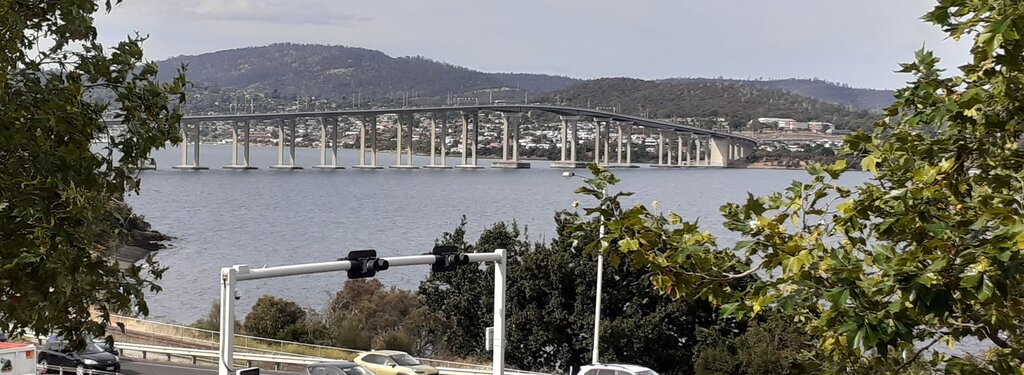
We rode along the coast along an old railway line and passed the start of the Tasman Bridge so diverted to admire the view from the middle arch which is sixty meters high. That also added another few kilometers to the route. Then a little more railway line until we reached Spectrum Engineering where a few boat problems were solved.
On the way back we passed through the botanical garden and the business district. The nine kilometers had stretched to thirty. The track is at Alltrails.
A few days later it was time to summit Mount Wellington. It stands high above Hobart and can be seen from everywhere. There is a road all the way to the top and it is “only” 1271 meters high. The advantage of starting from a boat is that you always get to cycle every single meter.
The first half of the route up was fun as we wound our way through the forest and past reservoirs, gaining height all the time. At about the time when I started to think that it would be nice to reach the summit, there was a sign saying that it was still another 12 kilometers and 800 meters. And yes that is an average of 7% for 12 kilometers. Some nice person had painted the distance on the road every kilometer so you always knew exactly how far you still had ahead of you. And the average may have been 7% but there was some 10%!
Luckily there were superb views, lots of shadow and occasionally a following wind. Heidi cycled everything but I occasionally had a stroll next to my bike to move the strain to other muscles.
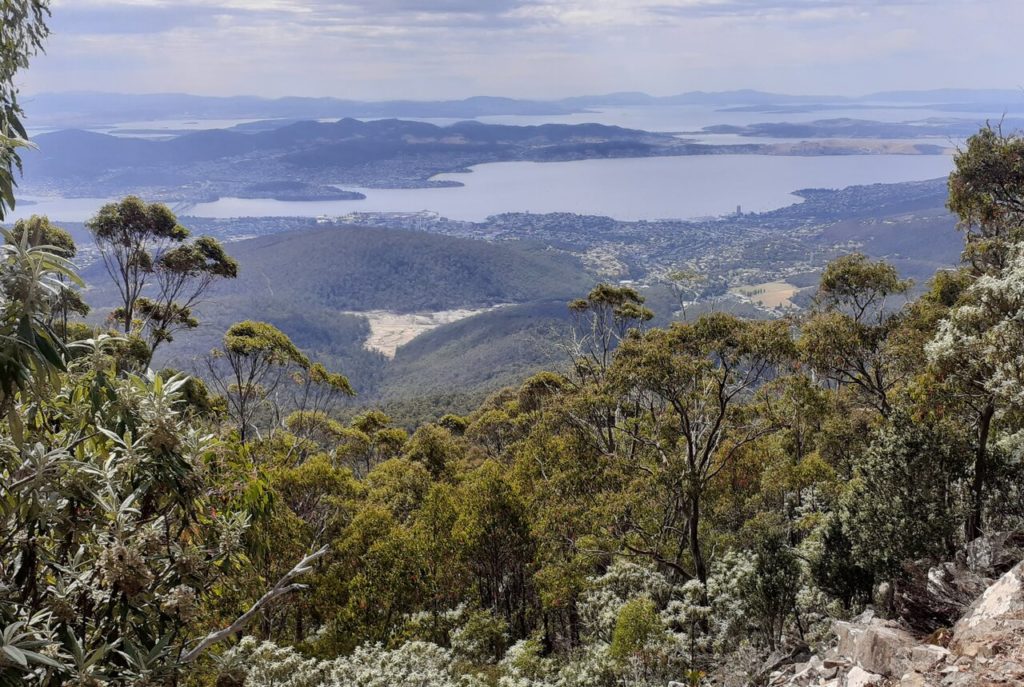
Eventually we reached the top having been passed by one bike all the way – an E-Bike! The views extend far across Tasmania and we could look down on the bays we had anchored in on our way here and Artemis far below us. It was nice that so many people congratulated us on our fitness or stupidity. Most people we met could not even envisage the climb we had just done.
It took four hours to climb the mountain and less than one to descend even though we did two beautiful off road trails heading down.
After cycling on Maria Island we had “a little bit of stress” as we only had a week to reach Hobart in time for the legendary Wooden Boat Festival. We had heard about this event while in Bundaberg and it was “only” 3500 kilometers away. We had been heading towards it since October – four months ago. It is billed as the largest show of its kind in the Southern Hemisphere and everyone said it was amazing.
To reach Hobart, we took a shortcut through the Denison Canal. Luckily Ivan from the wooden yacht Laurabada was transiting on the same day and coordinated with the appropriate authority to have the swing bridge opened to allow us through. We just had to negotiate the treacherous bar and shallows to reach the canal entrance. Dougal, who lives nearby went down to the beach in the morning to give us an on the spot wave report and declared the bar “passable”. We are so lucky to meet such amazingly friendly and helpful people.
After lots of hard sailing against the wind we turned the corner around the Iron Pot lighthouse and sailed the last few miles directly downwind to anchor off Tasmania’s capital city of Hobart. The next day Paul and Lucie arrived and we had three boats around us that we knew from Brisbane (2021), Bundaberg (2022) and Tasmania (2023). The sailing world is a village.
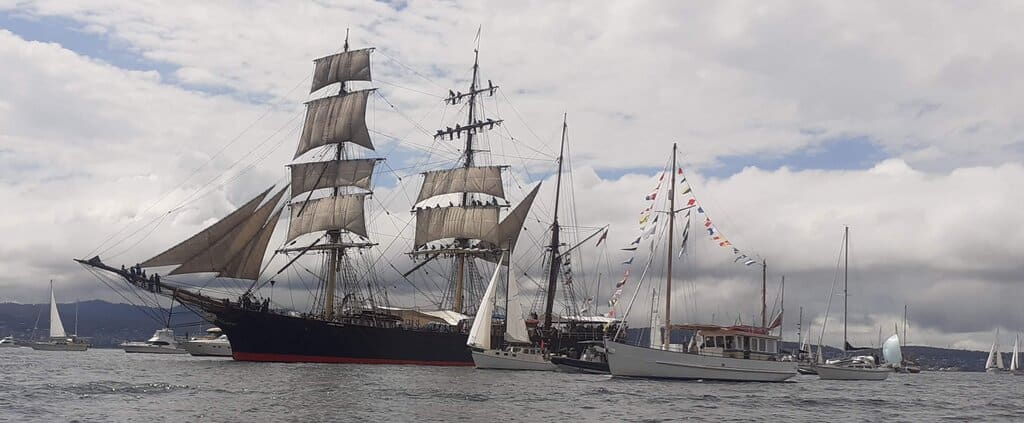
The Wooden Boat Show starts with a procession of vessels up the Derwent River so we took our dinghy out and tied to a buoy in the middle of the river and waited. We were approached by a wall of sail as everything from the 670 ton “James Craig” to tiny skiffs set sail and headed our way. A few years ago we watched an Atlantic Rally leave the Canary Islands but nothing can compare to the sight of so many historic boats sailing in company.
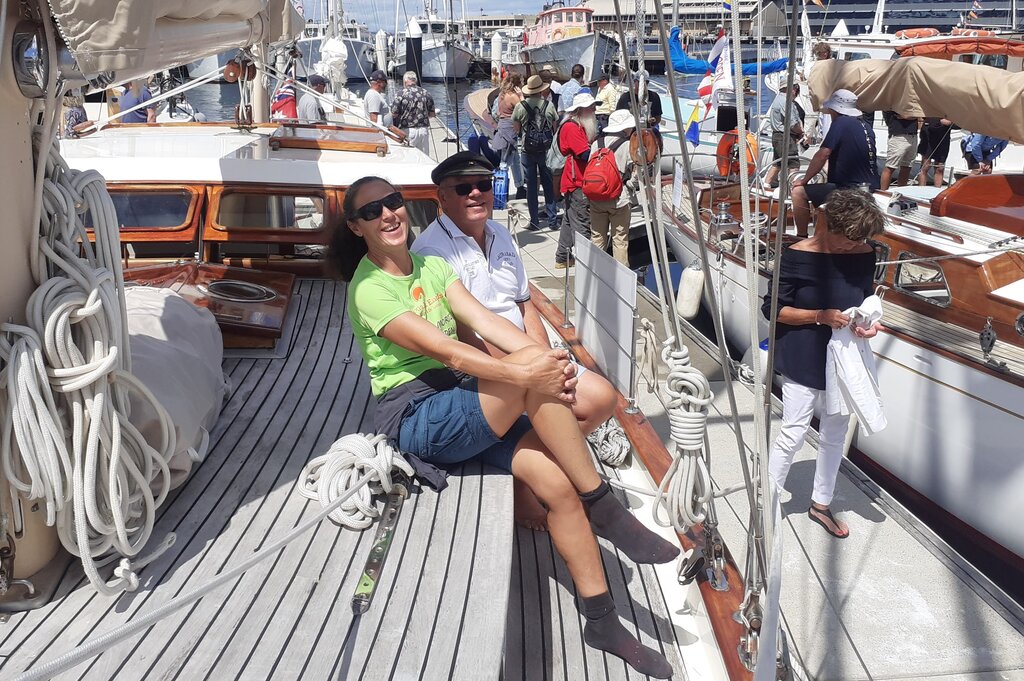
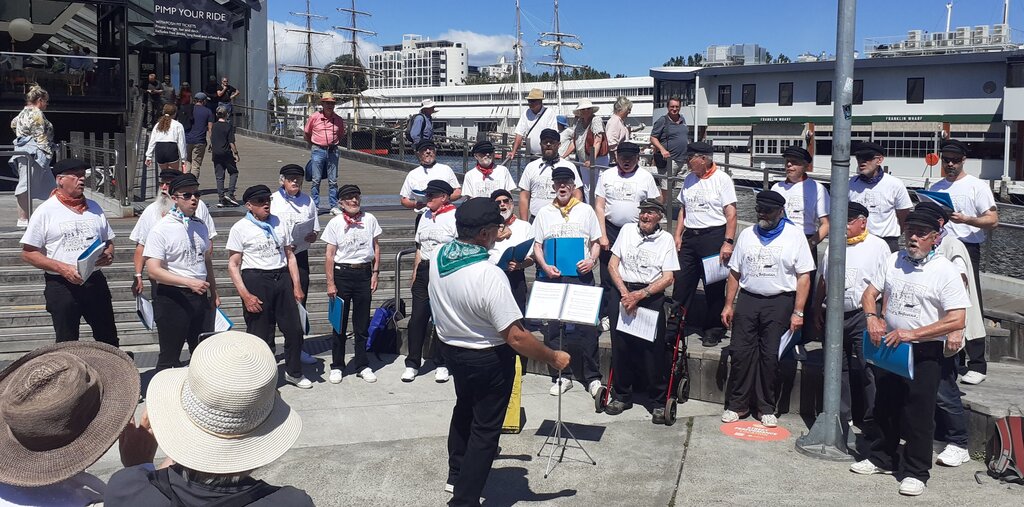
In the afternoon and on the following day we visited the show in the center of Hobart. It was an incredibly interesting event made even more so by meeting people we already knew. They, in turn, introduced us to others and, as soon as they mentioned that we had sailed from Scotland, we were immediately made unbelievably welcome.
Ivan invited us on to his beautiful 49 foot ketch and showed us not only the whole boat but also photographs of her history including her build in 1953 by his father. Various other owners called past which allowed us to learn more about treating and varnishing wood in an hour than in the last five years.
Dougal made us welcome at the Royal Institute of Naval Architects booth and introduced us to his family, a colleague who trains ships captains and an inventor who has designed and built an amazing underwater work robot.
The boats were all beautiful and a far cry from modern plastic boats but we both agreed, we love our Artemis and don’t miss having all that wood that needs so much attention.
The weather forecast said “storm” but luckily down here in Tasmania the weather doesn’t read the weather forecast and does its own thing. The result was that we were on our way to hide up a long inlet when we noticed that things weren’t as bad as they were meant to be. Ten minutes later the inlet had been replaced with Chinamans Bay off Maria Island. We arrived just as the rain began.
05:45 Alarm clock goes off. Quick weather check. Blue skies.
Breakfast. Get the dinghy in the water and the engine on. Dress for cycling. Get the bikes out of the boat and in to the dinghy. Cross to the island and find a landing place. Build the bikes together.
08:10 on the bikes and off exploring Maria Island.
The island is uninhabited except for two park rangers who stay in “the city” at Darlington and the first ferry arrives just before nine so, to begin with, it was just us two and the kangaroos and the wallabies and the pademelons and the geese and the penguins and two extremely relaxed wombats. We cycled between the hundreds of “locals” who were all obviously confused about how we were there so early.
We passed ruins dating from the time when the island was used as a convict island and then took the “main road” through the forest to Darlington. The dirt track was well graded, gently rolling and completely devoid of motorized vehicles so perfect for mountain bikes.
In Darlington we found the “town” that was originally built as a penal settlement and later used as an industrial town. At the information office we asked about obtaining a park pass. The lady was a little surprised as you have to show your pass to get on the ferry. Theoretically you can not reach the island without a pass. We explained that we had sneaked in the previous evening and landed at dawn unseen by any one but the local wildlife at which point she thanked us for our honesty. It didn’t help though. The lady had no passes, the phone number she gave us only has an answering machine and the website won’t process us.
We had been advised to visit the old lime hoppers and sing in them which we did and thoroughly enjoyed the amazing acoustics as our voices reverberated around us. I admit that this was not an activity we would have thought of ourselves.
our “lime hopper” concert
Leaving the town we cycled up a steep grassy hill (Heidi cycled – Neill cycled half way and then pushed.) At the top of the hill we were rewarded with a fantastic view back across the sea we had crossed the previous day with Mount Amos on the horizon. We took pictures and then continued back in to the forest and up to the islands reservoir. Back in town we visited the museum and were amazed to find an Irish visitor sat playing the perfectly tuned piano. What a treat.
Irish lady on a Tasmanian island
We headed back in to the bush and stopped off at an abandoned brewery / winery for our picnic. There is so much to see on this island but the clouds were already appearing to remind us that we were on borrowed time this outing and we should be getting on.
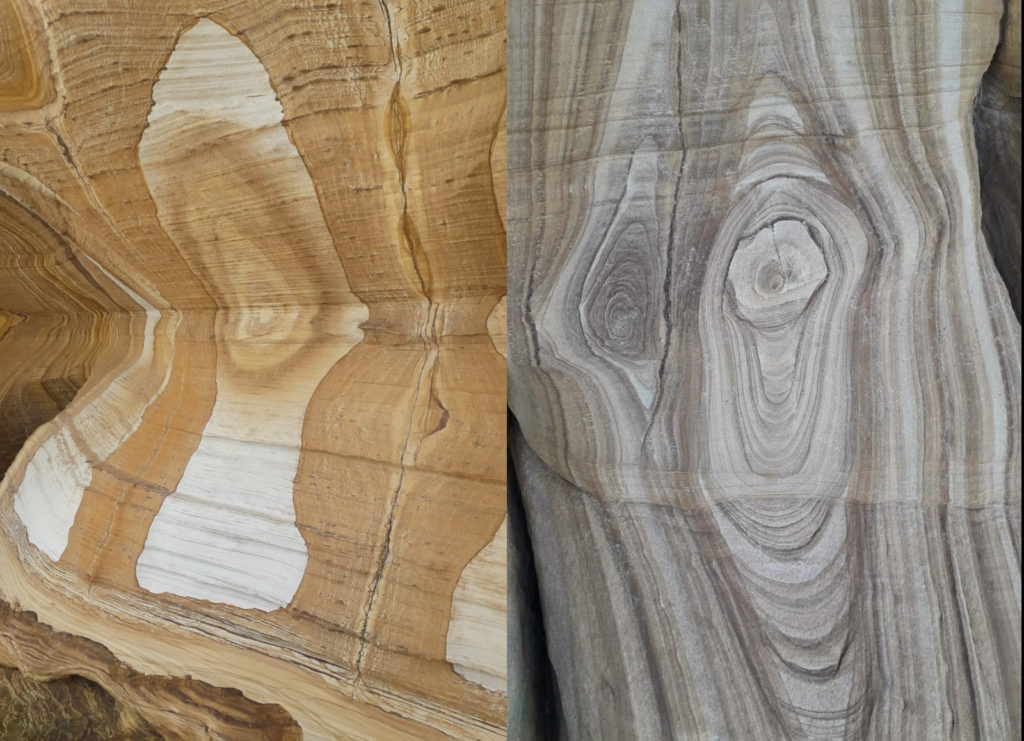
On our way back to the boat we stopped off at the painted cliffs. These are amazing and no photo can not do justice to the colors and textures of these rocks. You could almost believe that the aboriginal great father of all spirits had been painting here back in the dreamtime.
Back at the dinghy we reversed the morning activities and, before the winds arrived were packed and showered with a coffee in the cockpit. Being situative is half the secret to being lucky.




 technische Schwierigkeiten.