Welcome to Australia

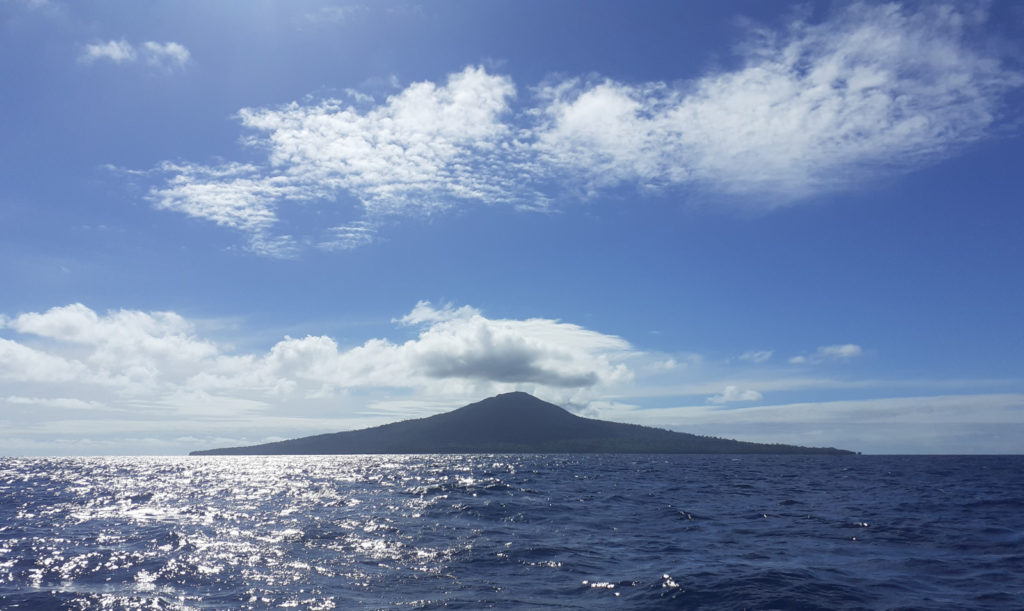
Far off on the horizon we could just make out some hills that we knew to be part of Australia. Land Ho!

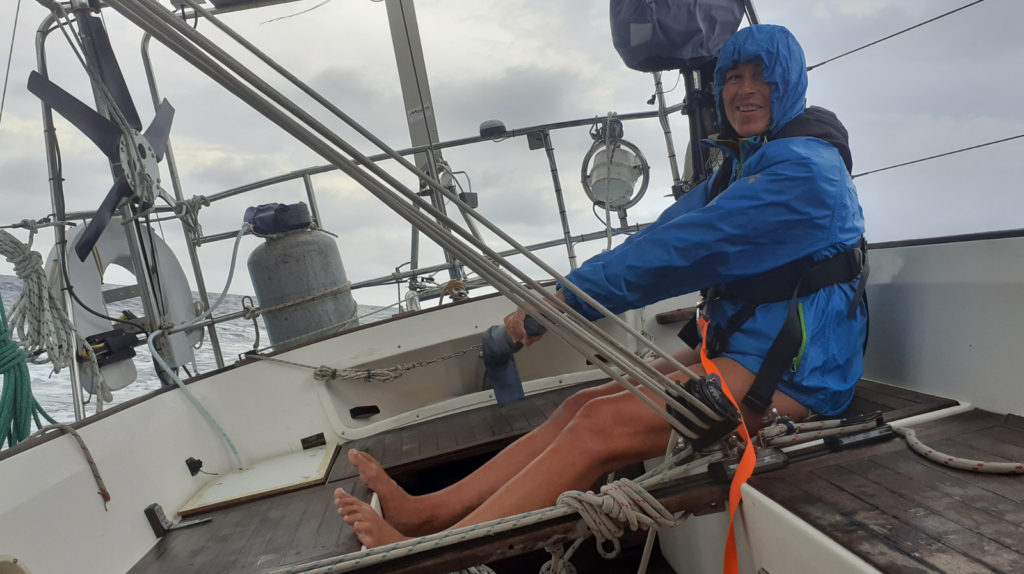
The first boat we met was “Texas T” and they were kind enough to photograph us with fully reefed sails as we headed for Brisbane harbour. The coastguard were warning of an approaching storm every hour and we were caught by it just before we reached the safety of Moreton Bay. Another sailing boat, maybe two hours behind us, was not so lucky and was blown south – hopefully to take refuge at Southport, further down the coast.
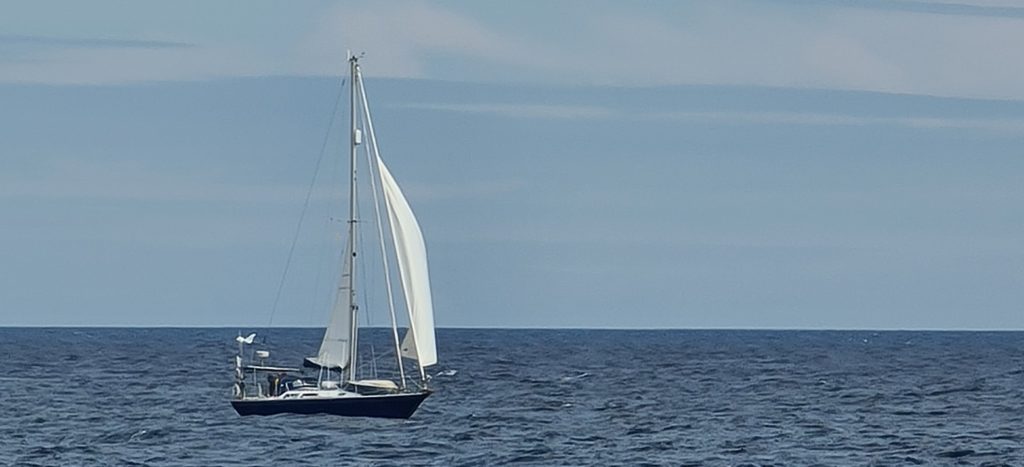
Artemis after entering Australian waters

We passed the fairway buoy that marks the beginning of the ships lane just before dusk and spent the night sailing south with the strong winds and swell following us. We had to ensure that we remained in the marked channel but at the same time avoid the monster ships leaving the commercial port of Brisbane. Each meeting was preceded with a quick radio conversation

“Monster ship, Monster ship, this is Artemis! Over.”
“Artemis this is Monster Ship on Channel 12! Over”
“Monster Ship, we are the tiny sailing boat heading your way with a dim light in the mast. We should meet in about 10 minutes and will keep well to starboard. Over”
“Roger that Artemis! We have you on visual and radar and will pass you red to red. Thank you for the info. Out!”

At least the port pilots spoke English English. A tug pulling a barge passed us to starboard and his Australian accent was so broad on the radio, I was not sure of everything he said. But he avoided us as agreed.

Once we reached the river mouth we turned upwind and drifted backwards and forwards for four hours to wait for daylight, wait for the incoming tide and, most importantly, finally sleep a bit. Until now we had both been catnapping while the other one held course.

At dawn we sailed up the Brisbane River. We passed the container terminal, the cement works and huge factory complexes. Just one tiny sailing boat being pushed by the wind between this landscape of industrial giants.
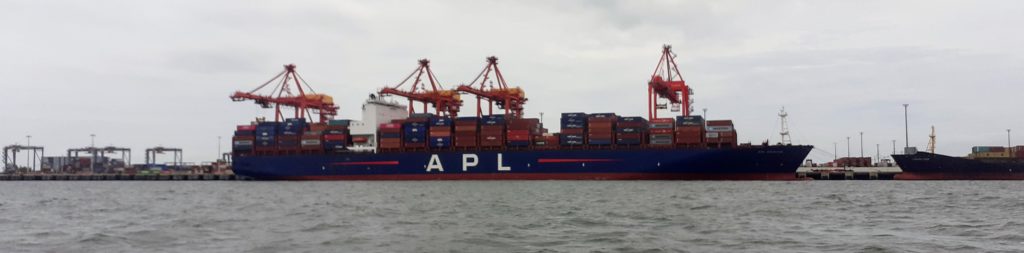
Container terminal

After about eight miles we reached the marina, turned in to shore and Heidi passed our bowline to a waiting dock-master. After 45 days at sea, we finally made it. We had done it. We had crossed the Pacific, the worlds largest ocean. We held each other tight, kissed and laughed.

The Australian Border Force had three officers waiting on the pontoon. They told us they had been following our progress via satellite and were a little confused and worried about out four hour “drifting around” in the night. They checked our papers and then said “welcome to Australia!”

Next was a gentleman from the Ministry of Agriculture. He should have checked our boat for animals and plants but couldn’t as we may have Covid so told us to ring him when we get out of quarantine.

The Border Force passed us on to the the Queensland Police who scanned a few documents and then discussed cricket with us while we waited for a taxi. The taxi ferried us to a quarantine hotel while being followed by the police (to ensure we didn’t make a break for it during the journey). At the hotel there were more police and medical personnel to process us safely in to our hotel room for 14 days quarantine. Twelve government employees for two sailors. Not many countries are that welcoming.
Halloween at Sea

The last day of October and the 34th day at sea on our way to Australia. Polynesia is two and a half thousand miles behind us. The Cook Islands, Tonga, Fiji and New Caledonia all came and went. Ahead of us is Australia, “just around the corner”, eight hundred miles away.

The day started with no wind but blue skies and remained that way all day. Sailing was not an option – even we can not sail with no wind. Before breakfast Heidi said “Let’s just have a lazy Sunday”.

During the morning coffee we learned French reflexive verbs to keep the brains working. Heidi made fresh bread for breakfast which we enjoyed in the cockpit surrounded by ocean. Not everyone has an uninterrupted view across a thousand square kilometers of the world from “the balcony”.

As there was no wind we ran the motor for half an hour to check it still works. We found condensation below the diesel filter so bled that off and then reprimed the diesel pump.

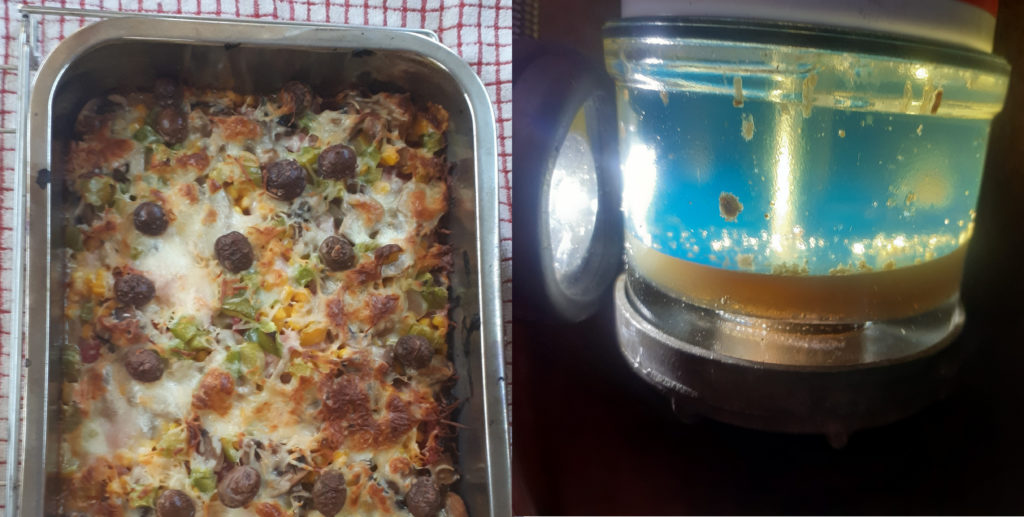
pizza is great. Water in diesel – not so good.

The motor had warmed the water up and the sun was shining so we washed the bed sheets, a few towels and us.

We also repaired the jib furling line and hoisted the main to sort out the furling lines. The mobile Solar panels we packed away ready for the forecast wind and Heidi cleaned the main panels. We documented a few things and finally sat down with a coffee and biscuits. I love these lazy days.

In the evening we made pizza. I did all the “easy stuff” – mix the dough and chop everything – while Heidi did the magic with herbs and the dangerous juggling of hot trays. We ate in the cockpit as the sun set.

We had just finished washing up when the wind came up so we set the sails and set off once again sailing west.

Another fantastic day on Artemis.

Time and Distance

It is only three years ago that we sailed across the Little Minch to the Hebrides. Having spent a few weeks sailing amongst the Inner Hebrides, this was our first “Crossing” – twenty miles from the end of Skye to the safety of a deep fjord. The pilot book warned that the sea could be rough, the weather forecast promised a storm in 24 hours and we could hear passing ships on the VHF radio.

We were a little excited but the crossing went well and we were satisfied to have achieved our destination and be huddled at tbe end of Loch Seaforth.

Mid Pacific

As we worked our way south we crossed from Scotland to Ireland then on to Wales, across the Bristol Channel to England and then across the English Channel to France. Each crossing increased our confidence and a “quick” day jumping from A to B became routine.

The “big Adventure” was the Bay of Biscay”. 350 miles, three to four days at sea and years of hearing horror stories about this ship eating Bay. After much planning and a reprovisioning, we took three and a half days to arrive in Spain and were very proud to have such a crossing “under our belt”.

From Spain to the Canary Islands was 600 miles and on to Cap Verde another 900 but by now “a few hundred” was not something we thought much about. A quick trip of 80 miles between islands was “just for fun”.

The Atlantic crossing was once again a “step up the ladder”. Firstly it was an ocean crossing and secondly it was twice as far as anything we had yet undertaken – over 2000 miles. We were at sea for eighteen days and proved what we already knew – we like sailing and we like being together.

Late Island (Tonga)

To Columbia was 300 miles, onwards to Panama was 400 and the Pacific sail to Ecuador 600. By now this all felt like “puddle jumping”. Check the weather, provision and leave. Sail if there was wind, drift if not and arrive one day.

From Ecuador to Easter Island should have been 2000 miles but, thanks to Covid, we ended up taking 54 days to do 4000 miles. After that experience we thought nothing of “popping down to Raivavae for Christmas” – it was only 500 miles each way.

And now we are on our way to Australia. Yesterday – after 38 days – we achieved the 3000 mile mark but the feeling was a bit “been there, done that!” Now it is only another 300 miles so “just round the corner”.

When you have time and enjoy sailing together, distance becomes irrelevant.

Sailing the washing machine.

We were sailing gently west happy to have escaped the doldrums of the previous five days. The sun was shining, the sky was blue and we were relaxed.

Davo sent us a short message. “You are approaching a ‘washing machine’. Wind variable. South, North, West and then South again”.

When the going gets tough – the tough get going

The first indication of Davo’s washing machine were the heavy clouds ahead and the rain showers. The wind stopped and then started strongly from the other direction. We changed sails and continually reduced the amount as the wind became stronger and the waves steeper.

Night fell quickly and, with no stars and no moon, it was pitch black. Turbulent black water under thick black clouds.

In the night the wind shifted sixty degrees within a minute. The boat turned so the sails were on the wrong side and the line of the towed generator wrapped around the windvane. Despite the wind and bucking boat, we sorted everything out, hand steered a bit then set up the windvane for the new course.

Twenty minutes later and course, sails, generator and windvane were all messed up again. Sort everything out, hand steer through the worst and then lie down – again.

At first light the wind changed again and we were heading East instead of West. The sea was a mess with swell from every direction but especially against us. Once again we were hand steering and getting soaking wet from the waves breaking across the deck.

Eventually we saw blue skies ahead of us and the swell became a little more normal. The windvane was back in action and we left Davo’s washing machine behind us. Hopefully we don’t repeat that night too often.

The world is round

Obviously the world is round.

But deep down inside, all those years of lieing and oppression by the church have left their scars in our brains. And at school there were always those big flat maps on the wall with nicely delineated edges. They taught us that Marco Polo went East and Christopher Columbus went west but not a lot about those who went “all the way round”.

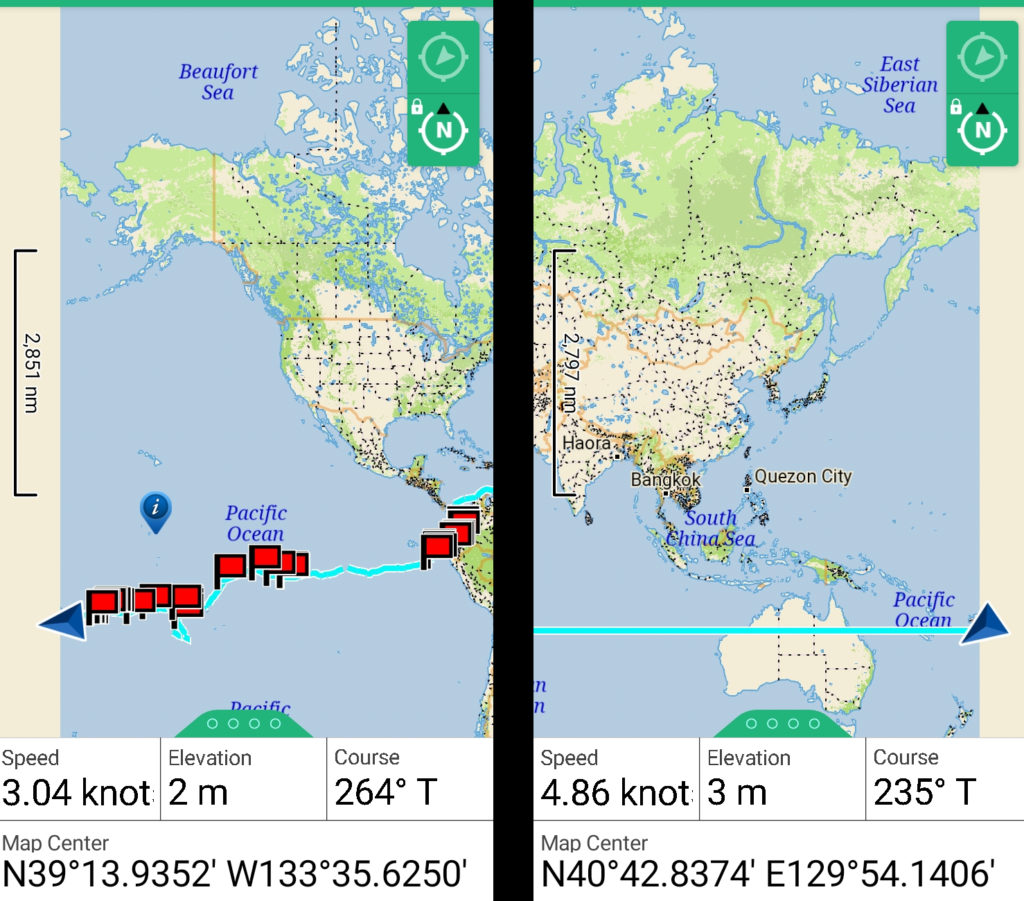
Even Garmin – who you would expect to be experts – suggest that there might be an edge to fall off. The map they supplied with our tracker goes East or West from London but stops beyond New Zealand going one way and Polynesia in the other direction.

Today was the day we were going to find out what really happened at “the edge”. Today we were due to reach 180 degrees west. The place where the western world stops and – supposedly- the Far Far East begins.

We both sat watching the degrees and minutes increase on the navigation system and “the edge” get closer on the Garmin.

179 degrees 99.999 minutes West arrived. And a second later we were in the East. Everything outside looked exactly as before and Garmin solved their “flat earth problem by “beaming” us across the map to the other side of their map.

Before and after crossing “the edge”

We celebrated having sailed half way round the world with wine and biscuits as Artemis continued heading across the open ocean towards Australia.

Pacific wind shear

Davo had warned us. “You will pass through a frontal system and the wind will shear from north to south.”

Today was Sunday so we decided to have a lazy day with no water making, no washing, no complicated meals, just a gentle sail. The wind was only a breeze so we spent half an hour launching the huge Parasailor. We were hand steering and even then we were still making less than two knots. The sky was overcast, we were heading (slowly) west and were relaxed.

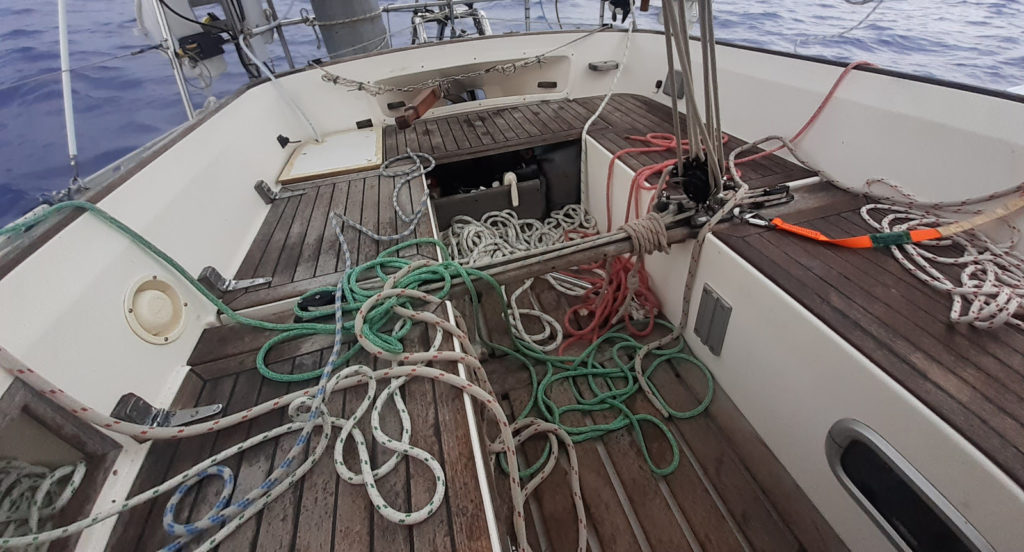
Heidi was steering when Davo’s wind shear happened. Suddenly, with no warning, the wind changed direction completely and wrapped the sail around the mast and rigging. The wind rose and the drizzle started.

The mess in the cockpit afterwards.

We turned the boat round to untangle things, dropped the parasailor in to its bag and got the bag below deck before it got too damp. The drizzle became rain and we got wet through changing the lines to use the jib. The wind came from everywhere and we did three jibes before we found ourselves sailing hard on the wind and through the rain to the north west.

After only an hour the wind dropped and we had to lash the tiller and reduce sail to a minimum to minimize the flogging.

And so ended our “lazy Sunday” – aching arms, wet clothes and a tiny boat rolling around in the Pacific swell while going nowhere.

The restaurant at the end of the day

As you sail west things get later. The sun rises and sets a little later each day. After a while you are eating breakfast while your friends in Germany are eating lunch. Later, their dinner time is your breakfast.

And then, finally on the other side of the world, you are behind everybody. The whole world has lived their day and gone to bed by the time you watch the sun set. You have reached the end of the day and ahead lies only the international dateline.

Sailing slowly past Tonga

Luckily the wind dropped and left us drifting only miles before the dateline. The swell stopped and we were left bobbing gently, totally alone in the middle of our private blue ocean. We were directly above the Tonga Trench and therefore eight thousand meters above the sea floor. A strange feeling to be sat in your home knowing the ground is eight kilometers below you.

Together we cooked Risotto “Esprit” with our last bottle of red wine. While it cooked through, we enjoyed a sun down drink in the cockpit – or as we like to say “on the balcony” – as the sun set on Wednesday evening.

At five o’clock on Thursday morning, while we were still cuddled up together in bed, we drifted across the dateline and Thursday became Friday. We got up on Friday morning having jumped over Thursday. We are ahead of the whole world and jump out of bed before any one else is awake.

So now, we have a great excuse for anything we should have done but didn’t. “It was planned for Thursday October 14th 2021!”

SOS. Palmerston Reef

It was a Sunday morning and we had been at sea for nearly a week. A week of seeing nothing except stars, flying fish and a few birds. We expected to pass the lonely atoll of Palmerston Reef before evening.

Heidi took a look over the stern of Artemis and said “oh s**t!”

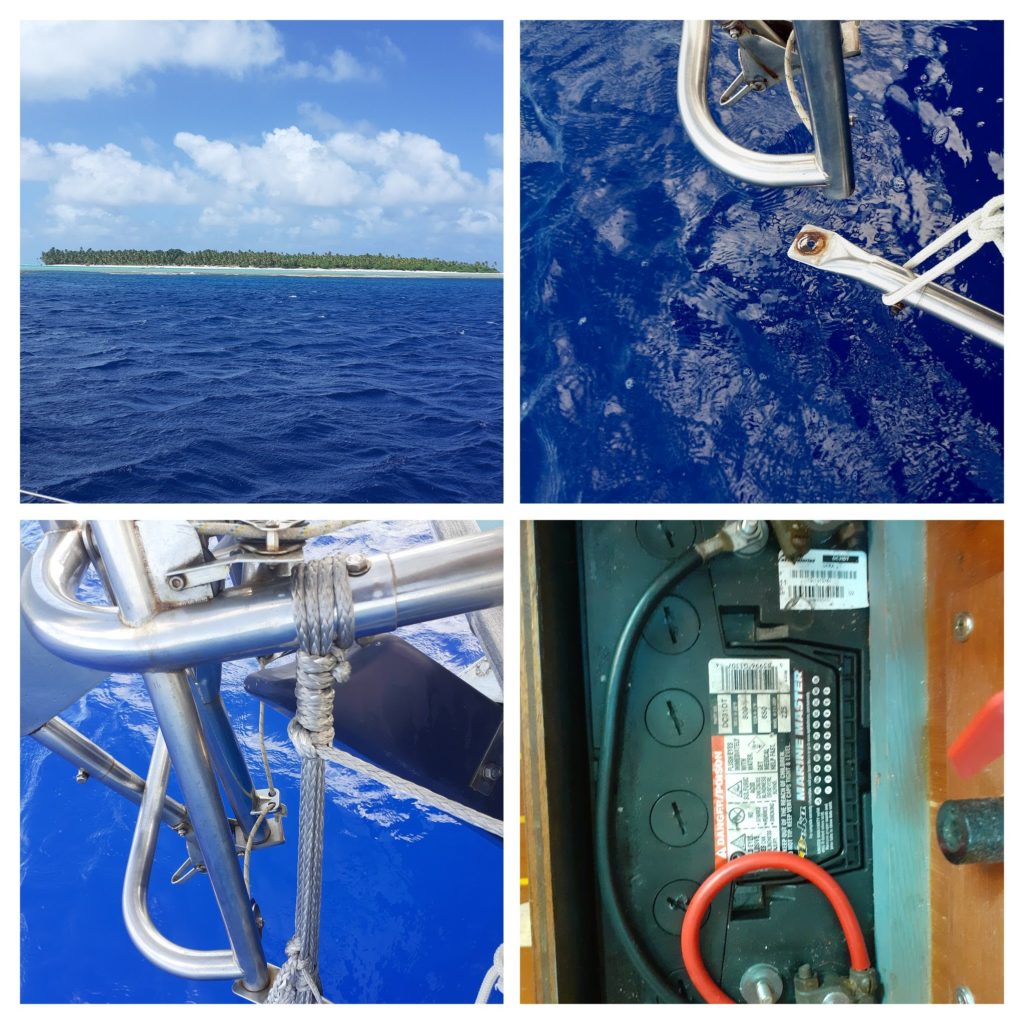
Our windvane, the device we call Ciara, who steers our boat day and night, should be attached to the boat with four legs. One leg was no longer attached. Heidi managed to lash the broken leg to the boat but we could not use the system and so began to steer by hand.

It is still over 2500 miles to Australia so Ciara had to be repaired. This was not going to be possible while bucking and rolling in the Pacific swell. We needed shelter. Palmerston was “only” seven hours away but totally closed down because of covid.

legPalmerston Reef, the broken leg, the leg strapped up with Dyneema rope, the new earth strap from battery to motor

We pressed the SOS button on our Garmin inreach; not something we had ever hoped to do. We immediately received an answer and within ten minutes we were connected to the New Zealand coastguard. Two and a half hours later we had received an emergency entry permission to anchor off Palmerston Reef on condition we did not go on land or have any contact with the locals.

After a few hours of sailing we saw palm trees on the horizon and made contact with the islands policeman per marine radio. He gave us permission to use a mooring buoy but warned that we needed to be very careful as they were no longer maintained and the wind could easily shift to blow towards the reef.

We started to strike the sails to take the buoy, pressed the motor starter and…

Nothing happened!

You can guess that we were not happy. The only safe buoy for hundreds of miles in any direction, a gusting 20 knot wind and we were going to have to sail on to the buoy. All those of you who have sailed will know that this was going to be “challenging”.

But after a few more tries the motor started. Thankfully we took the buoy and enjoyed the calm seas and no longer steering.

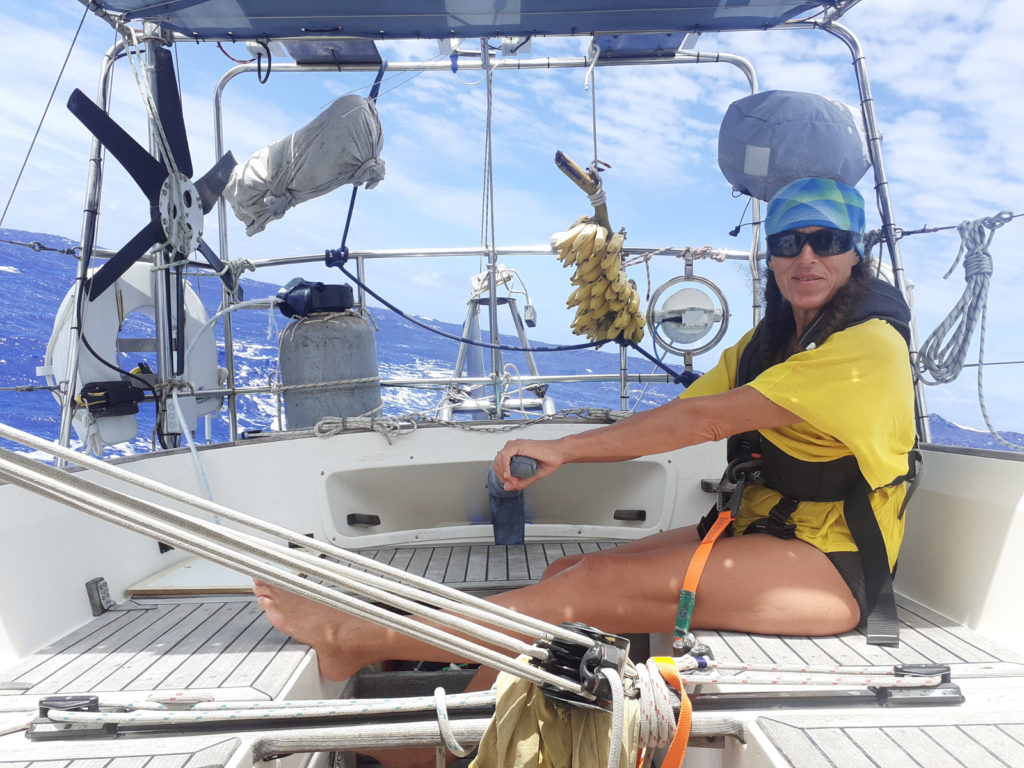
Hand steering Artemis to Palmerston Reef

After a very windy night, we began field repairs to the windvane. The bolt that holds the leg to the device had sheared off at the head. Luckily there was a bit of bolt still projecting so we could use that to position the leg and then we lashed everything together using a high tech “piece of string” called Dyneema. Maybe not perfect engineering but the best possible solution off a lonely reef thousands of miles from the next machine shop.

We think we found the motor starter problem – a loose earth connection between the battery and motor. We tightened it up and added an extra earth strap to be sure. After that the motor started first time but we will see.

With “the work” done we thanked our friendly policeman, showered, washed Heidi’s hair, set the sails for downwind, dropped the mooring line and, once again, set off westward.

Postscript: a few days further down wind, we discovered that the bracket that connects the windvane to the tiller had also broken and was only held by one screw. We also fixed this with Dyneema- Heidi steering while Neill made the repair.

Our time in French Polynesia

French Polynesia has 115 main islands and uncountable islets spread over an area the size of Europe. It has a population of a few hundred thousand people and five of them were difficult. All the rest were amazingly friendly and helpful to us.

When we needed a safe harbour at the start of covid, the mayor of Hiva-Oa and his crisis team around Marc, welcomed us to their island and gave us refuge.

On Hiva-Oa and the following twenty five Islands that we visited every one gave us fruit and vegetables. Mostly when we asked about the price they just laughed and said “You are sailors. It is free.” Even those who live from selling their produce always gave us as much or more than they sold us.

On Hiva-Oa a local man spent an entire day driving us around the island, showing us hidden treasures and explaining his culture to us. At the end of an amazing day, he would take nothing but our thanks.

On Makemo Atoll the ladies from the bakery lent us their tricycles to explore. During the annual dance festival, the mayor took the time in her speech to say how happy they were that we sailors were also present. At the furthest end of the atoll a hermit let us use his island to barbecue. He even joined us briefly until retreating to his lonesome home.

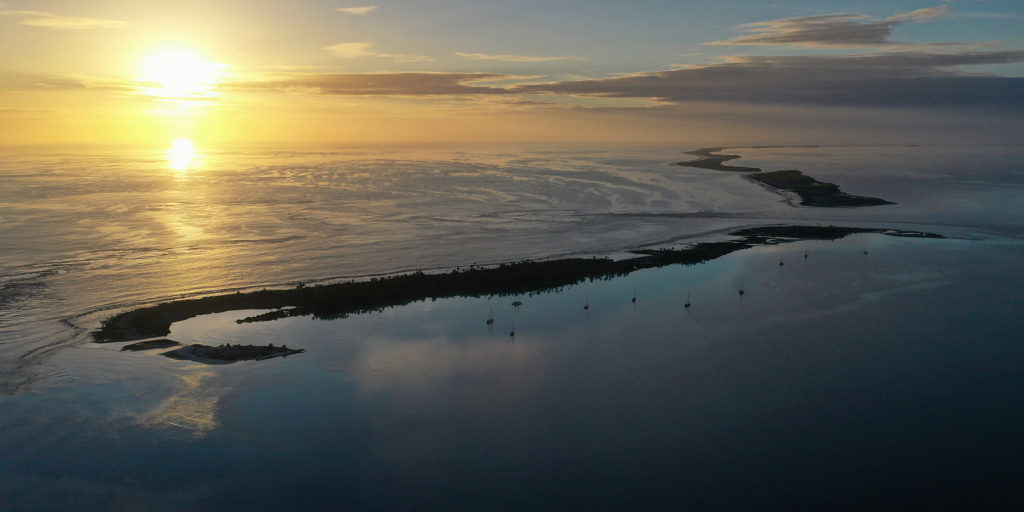
Coral atolls just for us

In Tahiti, when we were cold and wet, a hotel owner fed us, gave us warm drinks and organized help to escape the flooded valley. We would have paid but she insisted it was all free as the hotel was closed that day.

On Raivavae a local offered to bring us some bananas to the dock. When we met him he had two trees of bananas, a few other fruits and drove us to his fields to collect manuk (a root vegetable). Everything for free and when we gave him a banana cake as a thank you he said “Pour moi? Pourquoi?”

A welder stopped mending a garden gate to repair a broken bracket off our engine. When he was finished he laughed at the idea of us paying. “You are sailors. It is free.”

Volcanoes growing out of the Ocean

In Tubuai the captain of the Gendarmes spent three days introducing us to his island and the islanders by mountain bike. The restaurant owners treated us like family and the dentists wife showed us her mountain, nature and culture. She also organized an invitation to the official banquet with the president of Polynesia.

Back in Tahiti, we were both vaccinated against Covid before any one we knew in Germany even had an appointment.

In Rurutu we were given so much local produce that the farmer had to tie an extra sack on my back. And when it started raining we were invited in to a local party and given coconuts to drink while we waited for it to stop.

Everywhere the people did their best to understand our stumbling French and talked slowly with lots of hand signs to be sure we understood them.

We can never repay the kindness of the people of French Polynesia. We gave away a few t-shirts, invited people on board to visit or sail with us and rescued a broken down fishing boat but these were just one offs between the flood of help and joy that Polynesia presented us.

We will never forget our seventeen months with the people of French Polynesia.

Five Days

The wind has stopped. Sometimes there is a gentle breeze but not enough to fill the sails or move the boat. We are drifting slowly north at the mercy of the ocean currents. It is five days since the last real wind and we have no idea when we will be able to sail again.

We still have well over two thousand miles to go to Australia and enough diesel to motor about two hundred. All we can do is wait for the wind.

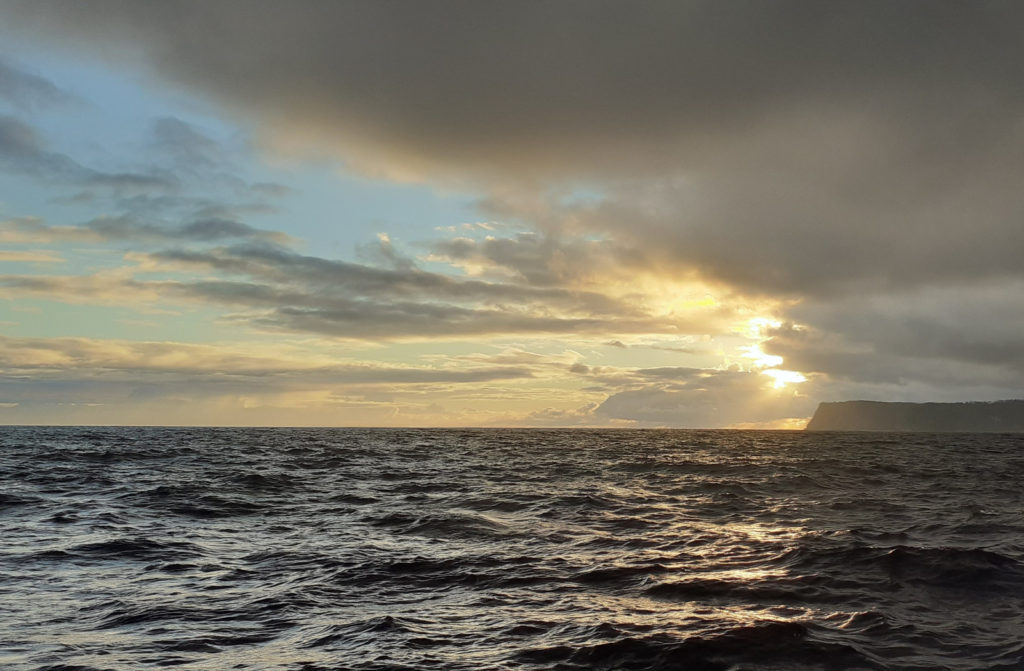
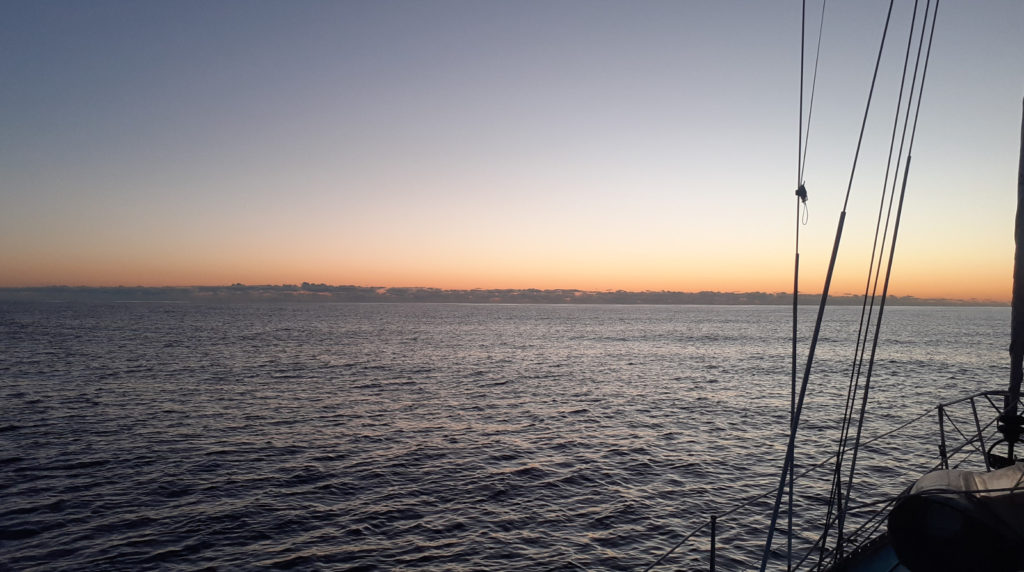
Passing New Caledonia at sunset

Five days! In my previous lives that was a working week. Time to fly to Texas and back to repair a machine. Or set up a new project with time plan, budget and milestones. Or cycle to Poland. Or provide a village with Internet. Back then, five days were full of action, decisions and successes.

And now? Now we sleep, watch the waves, read, cook, consider how deep and blue the ocean is, sleep, make water, play and enjoy the moon waxing each night. We have time. We aren’t going anywhere so we can just enjoy being here.