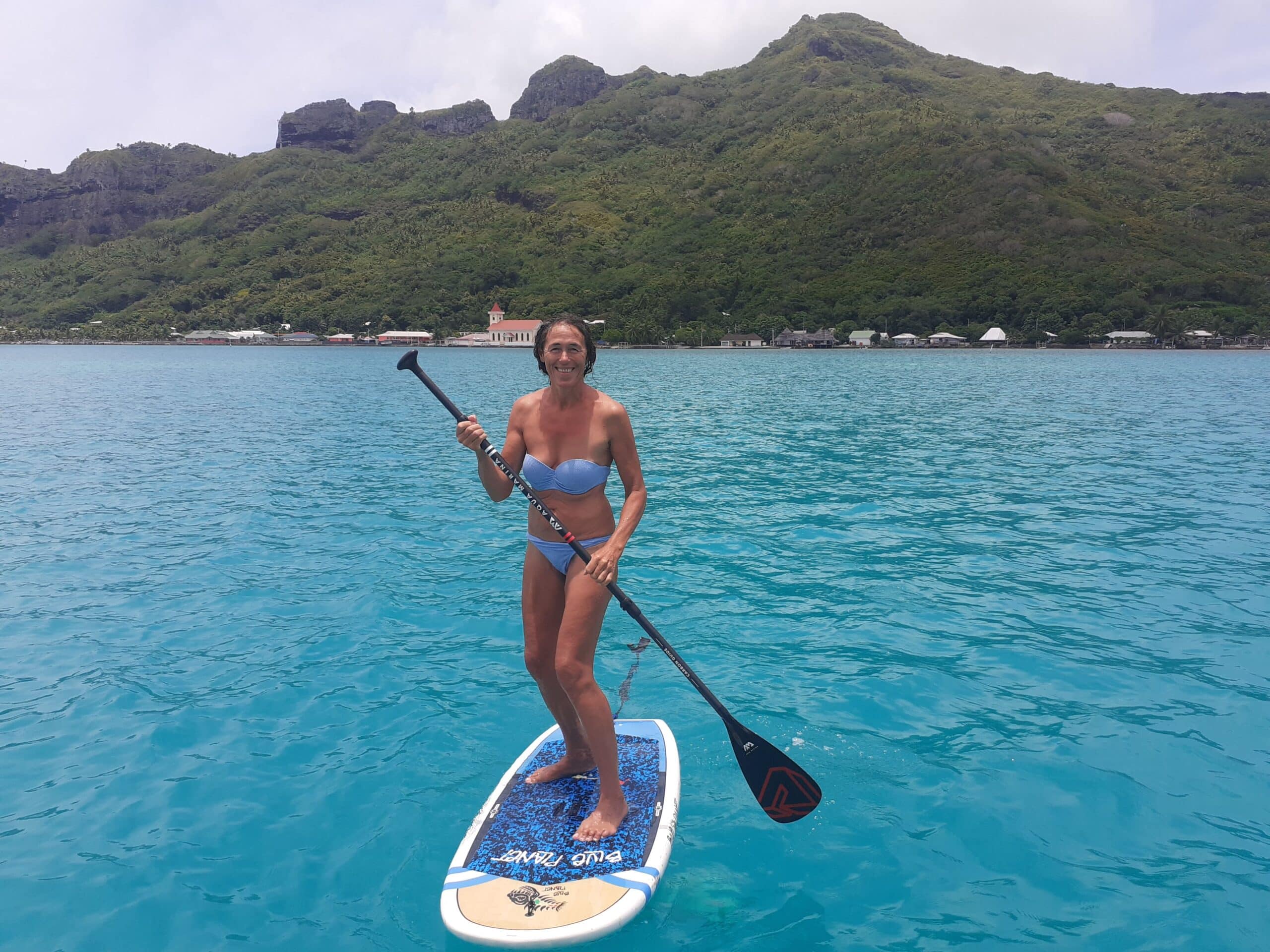
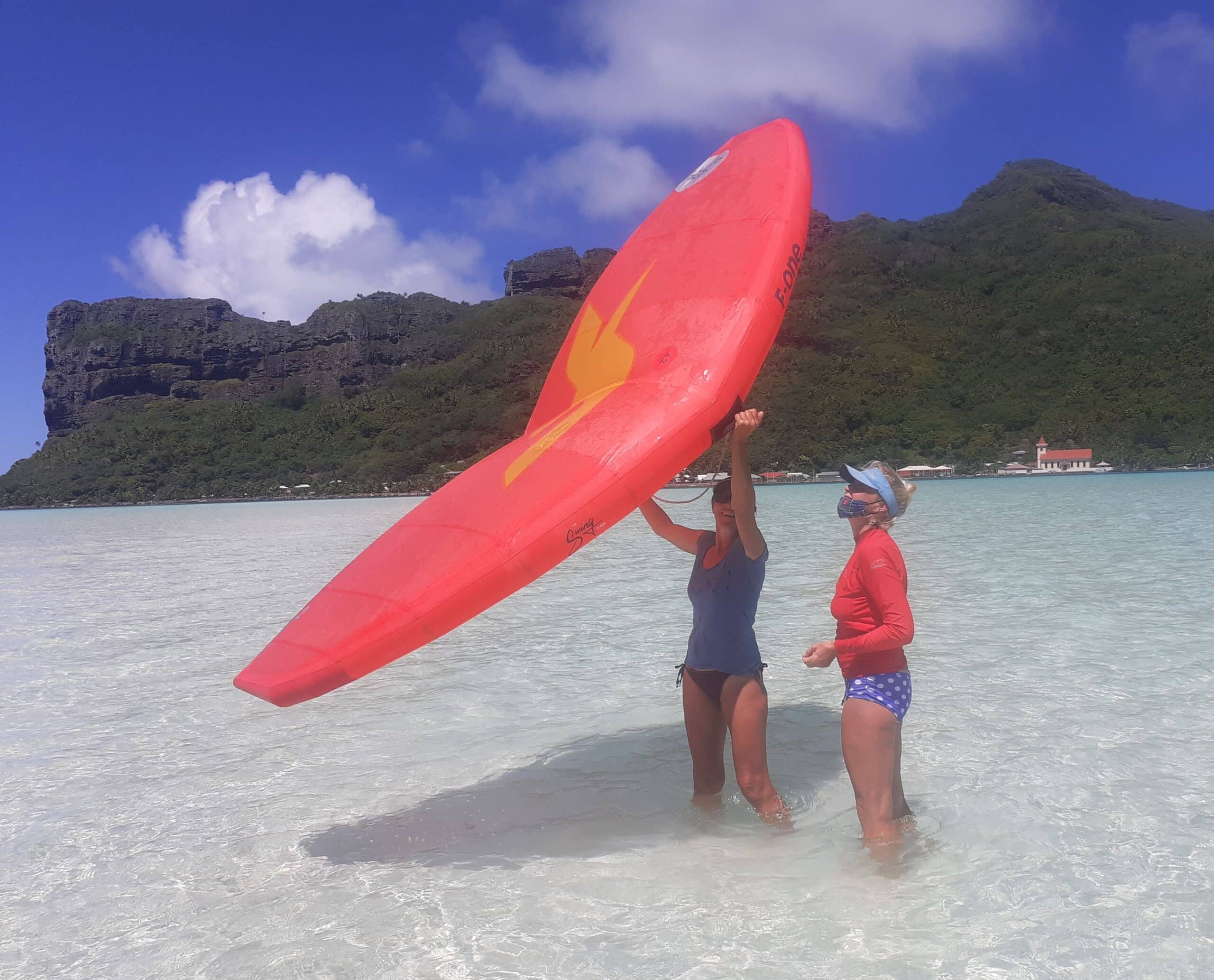
Endlich sind auch Sybille und Bo mit ihrer Segel Yacht Sybo hier in Maupiti eingetroffen. Nachdem die beiden in Tahiti ein neues Wing Foiling Board mit “Flügeln” erstanden haben wurde es hier natürlich sofort ausprobiert und getestet. Auch Neill und ich kamen in den Genuss es zu probieren 🙈🙈😆; zuerst Stehübungen auf dem Bord dann wurden wir – mangels Wind – hinterm Dinghy geschleppt wie beim Wasserski fahren 👍. Ich kann euch versichern, dass ich bestimmt 100 mal ins Wasser gefallen bin und mich jedes Mal aufs neue aufs Brett gestellt hab 😜😜 anstrengend, Kräftezehrend aber auch wahnsinnig witzig.
So sieht das Board aus
Unsere persönlichen Trainer Sybille und Bo hatten alle Hände voll zu tun um uns alles genau zu erklären und zu zeigen, damit wir es vielleicht doch schaffen könnten zu fojlen oder wenigstens zu fahren. Natürlich haben wir die “Flügel” auch testen müssen und nach drei Tagen ausgiebigen Training waren wir vollkommen am Ar… 😜 sämtliche Knochen taten uns weh und wir haben wieder etwas Neues gelernt und w7ahnsinnigen Spaß gehabt 👍👍. Nochmal tausend Dank an die Beiden 😘😘. Die gemeinsamen Wanderungen zum Flughafen, auf den Berg oder rund um die Insel waren eine angenehme Abwechslung ☺️ und unser nächstes Ziel haben wir bereits gefunden – auf geht’s nach Bora Bora 😆😆.
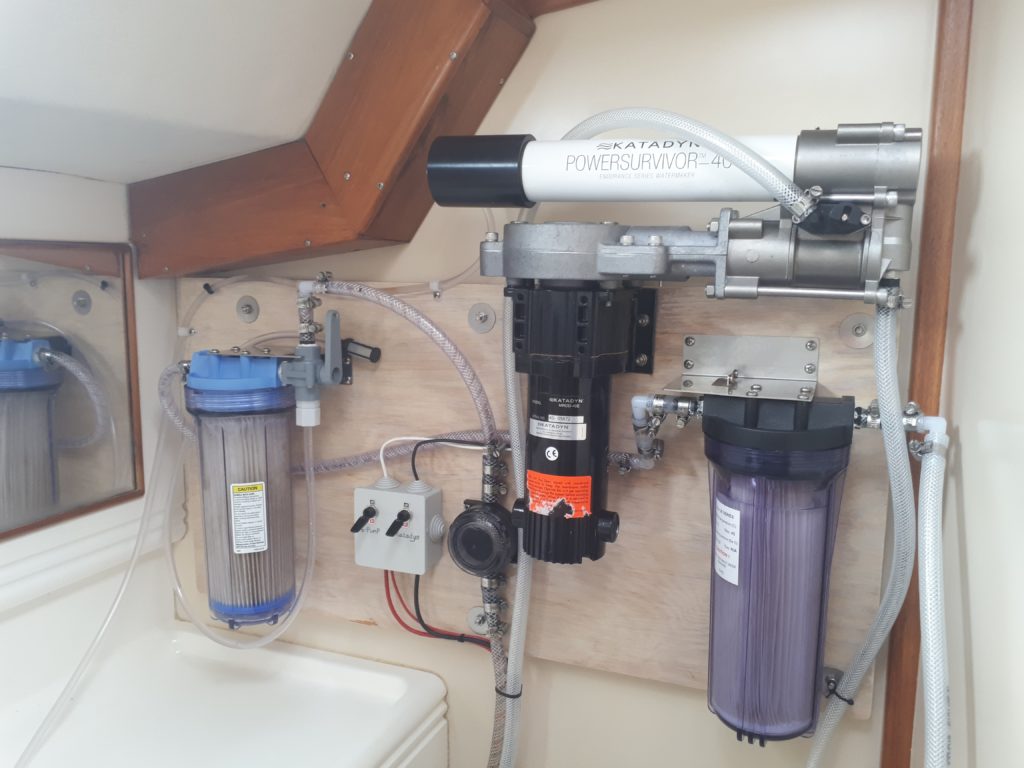
A year ago today, our Katadyn PowerSurvivor 40E water maker was finally working. Since then it has produced almost all the water we use. I write “almost” as we are not averse to collecting rain water – mainly for washing and cleaning.
A year ago today, our Katadyn PowerSurvivor 40E water maker was finally working. Since then it has produced almost all the water we use. I write “almost” as we are not averse to collecting rain water – mainly for washing and cleaning.
We spent a week away from the boat when we cycled in the Andes but other than that we have been living on board all year. In those 358 days we have produced nearly 4000 liters of water and have given away about 350 liters, so on average we use about ten liters a day. By pre-washing ourselves, our clothes and our dishes in salt water, we manage to live comfortably with that.
The system uses about 60 watts of electrical power and we run it only from wind and solar power. Unlike many of our neighbours, we never have to run our diesel motor or a petrol generator to produce electricity. The water maker is a good “energy puffer”; on days with too much power we can produce more water and on overcast, windless days, less.
The water quality has been good all year. We have regularly given the Seenomaden water and, after over twenty years at sea, they still say it is the best water they have tasted. We have a measuring device which always claimed our water had less than 300 parts per million (ppm) of salt in it. SY Mikado’s meter measured far less so we are not sure of the real value but our guess is an average of about 180 ppm.
Until now (touch wood) the system has run with no problems. We wash out and dry the two pre-filters every few days and occasionally lubricate the piston shafts as per the manual. We have seen black oily leaks from the piston shaft but they are irregular. We asked technical support for suggestions what it could be but received a standard “take it to a dealer” answer. Katadyn still do not appreciate how big the oceans are and how limited their dealer network is in the middle of the Pacific.
We bought a water maker to increase our freedom and that is exactly what it has done. If we want to stay a month on a dry coral reef, that is what we do. If it takes 54 days to cross an ocean, we still arrive with a full water tank. When the neighbours need water, no problem! We always have pure clean water and therefore a meal and a cup of coffee.
Technical bit. The PowerSurvivor has produced an average of 5.40 liters per hour during the last year. The flow rate is dependent on the battery voltage varying between 5.2 (under 12.8V) and 5.7 (above 14V). We have a pre-pump installed below the water line which can pump about 170 liters an hour through the pre-filters.
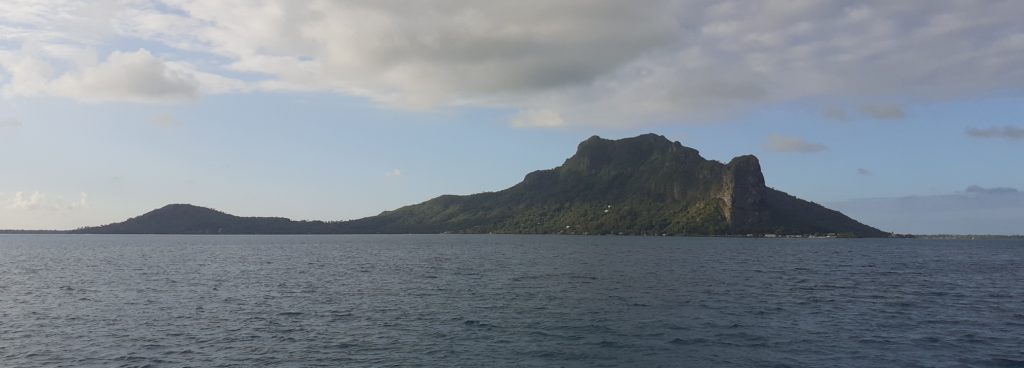
I recently wrote about the exciting journey to the Pacific island of Maupiti at the far west of French Polynesia. Look Maupiti up in the Internet and it is the impossibly small tip of an ancient volcano lost in the middle of the huge blue Pacific. You have to zoom in a long way to find it.
The volcano that originally created the island is slowly sinking back in to the ocean leaving a small mountain to climb and a huge reef all around the island to anchor behind. The island is green and fertile, the sea is many hues of blue and the locals are friendly. Another piece of paradise.
Turn left just after paradise
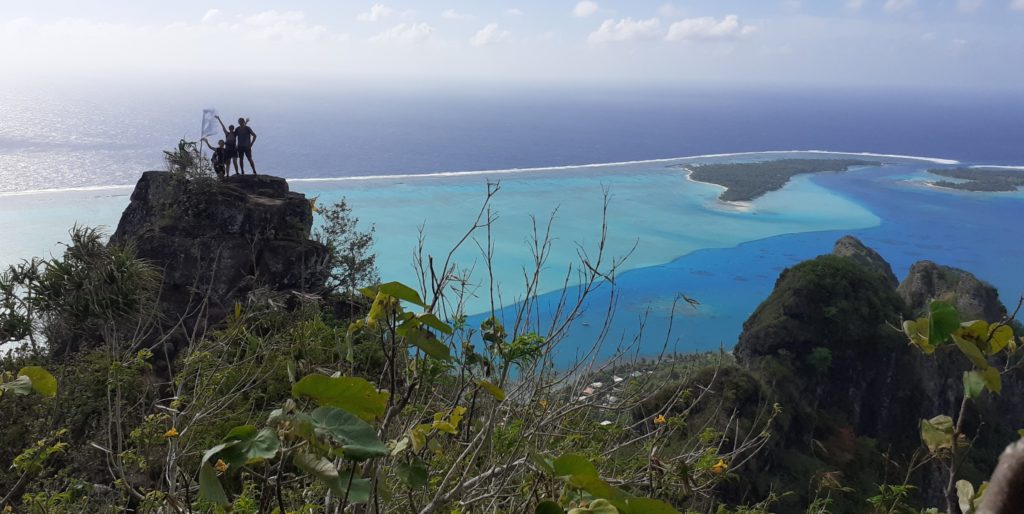
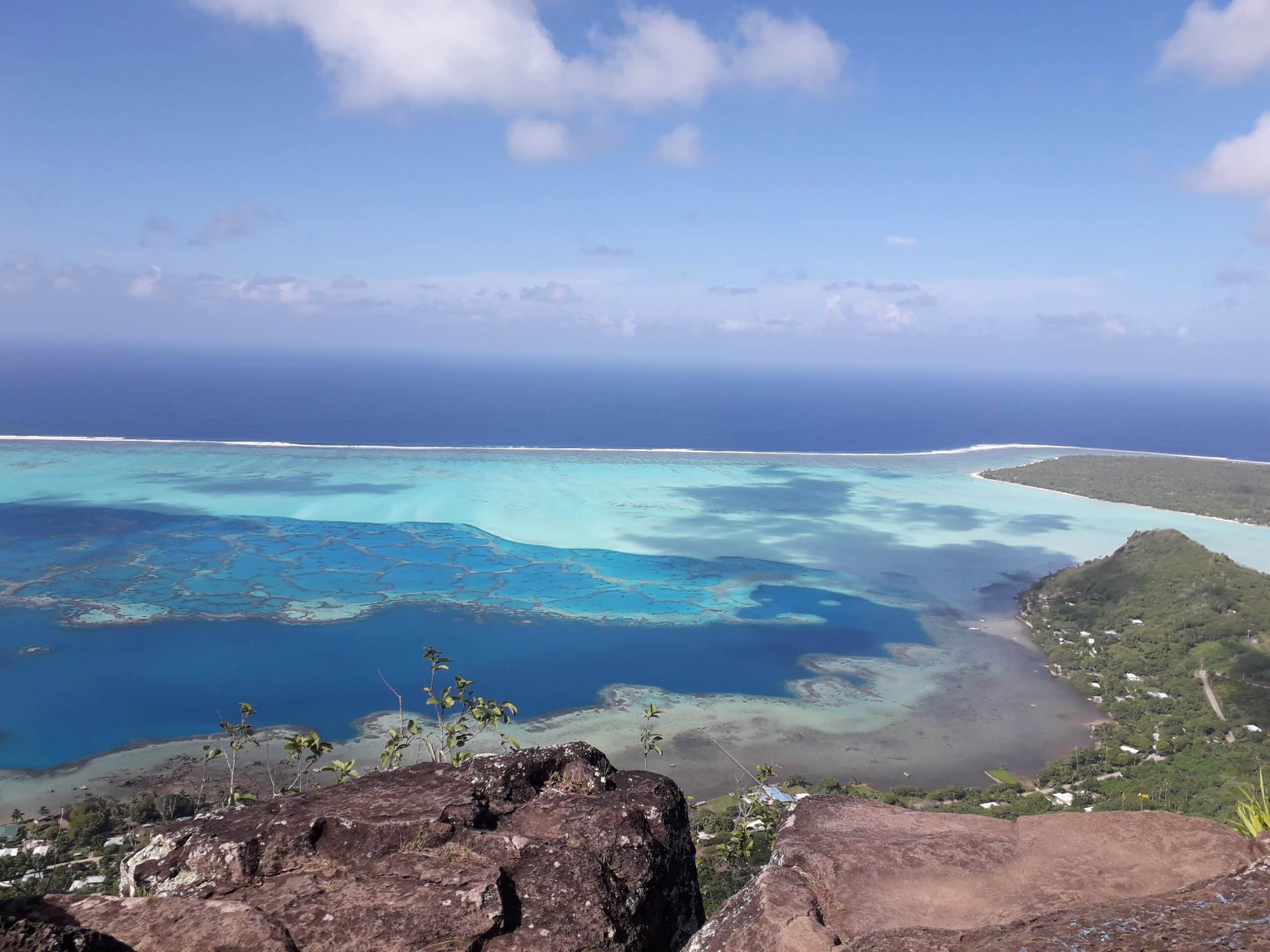
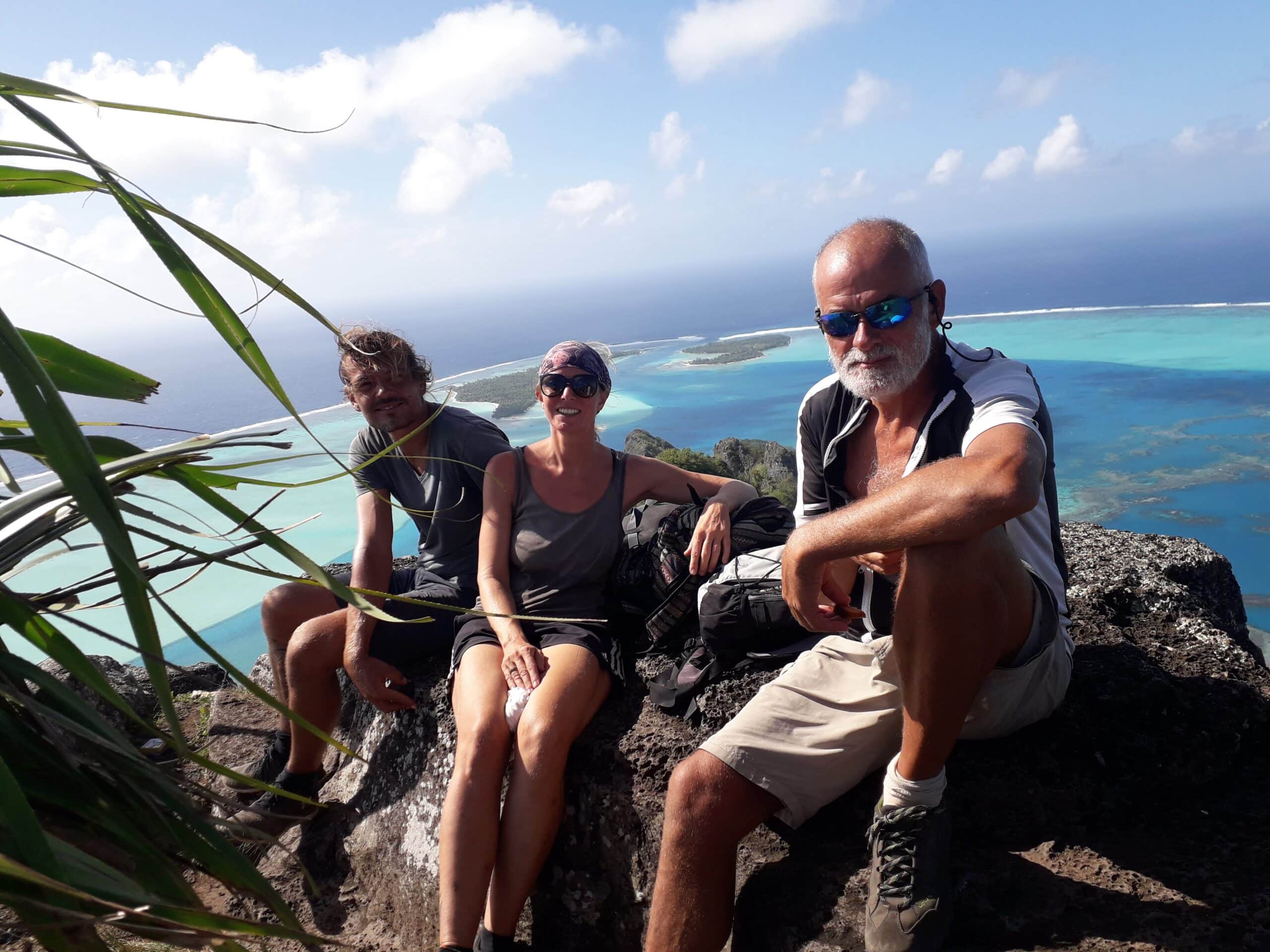
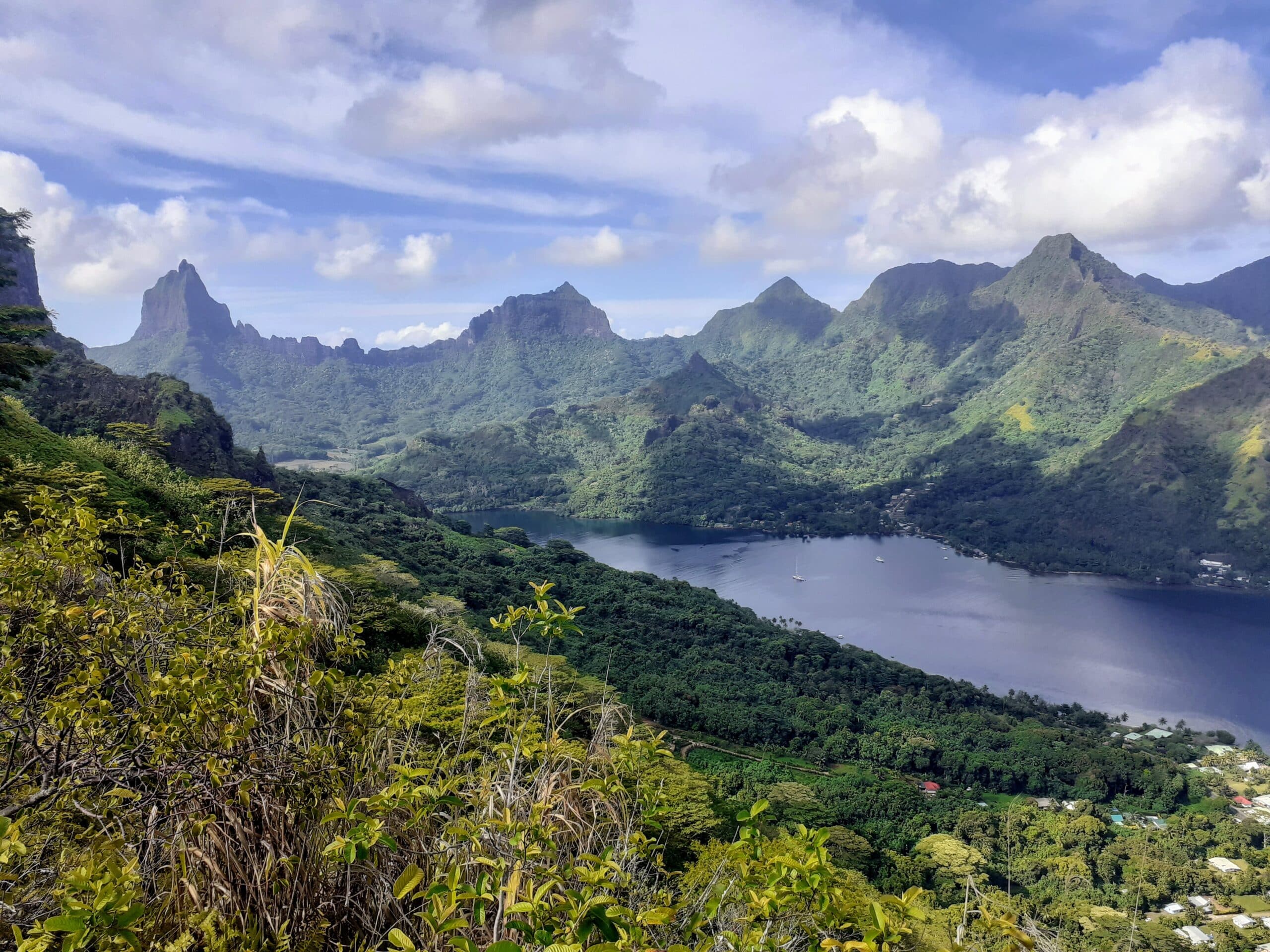
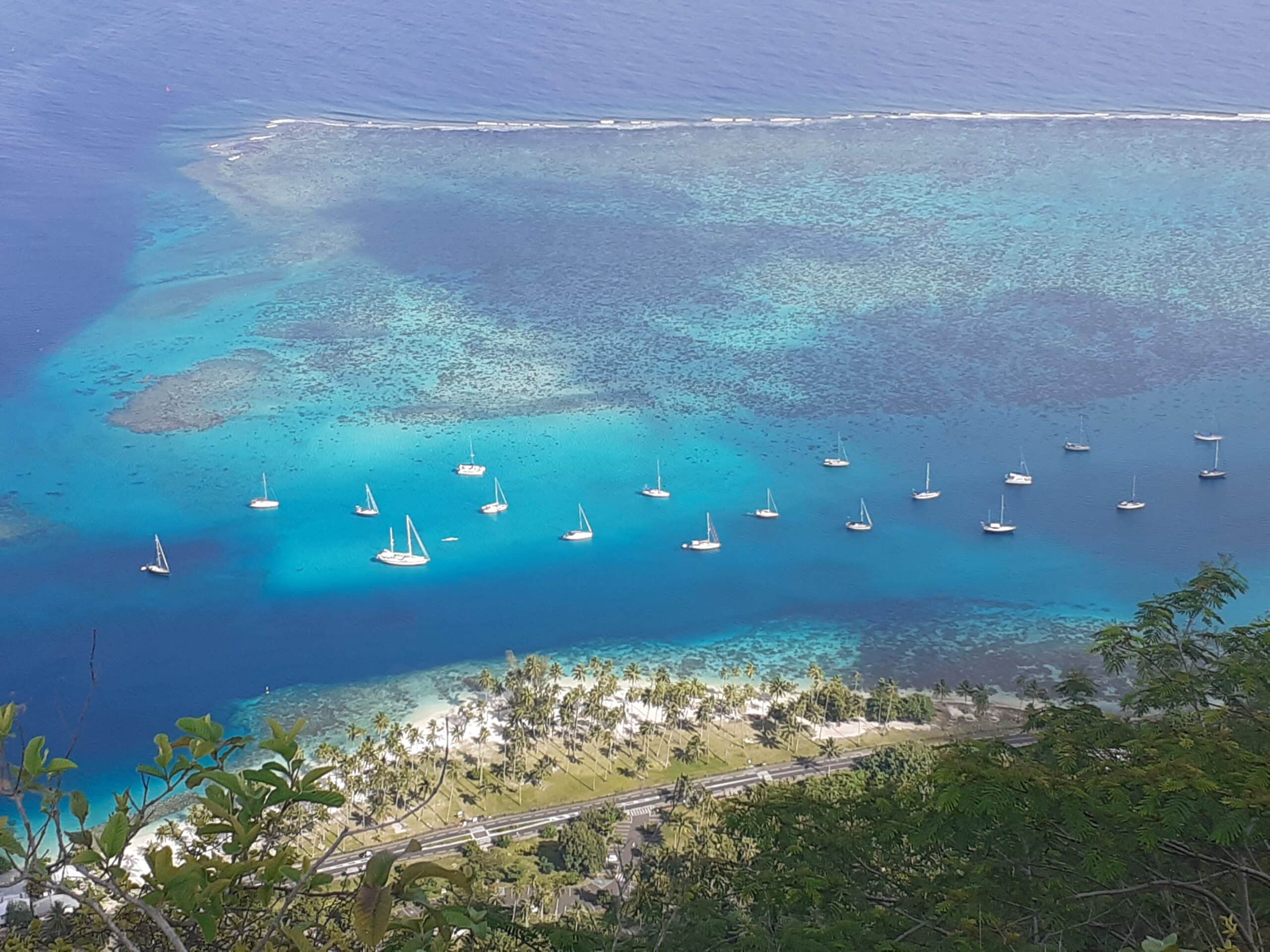
Together with Nicole and Georg from SY Mikado, we climbed to the summit of the island and enjoyed the panoramic views out to the reef and beyond to Bora-Bora on the horizon. Our boats were tiny little vessels floating in the aquamarine lagoon. A few days ago we watched Disney’s “Moana”, and thought “that is where we are!”
Manta rays come in to the lagoon to be cleaned of parasites by cleaning fish. We swam over to a rock that is used as a “cleaning station” and watched majestic mantas queuing for their turn to be cleaned. Nature is unbelievably well thought through and watching huge mantas swimming just below you is incredibly impressive. A few days later we saw a local family knelt in the sea stroking a stingray lieing on the sand next to them. When they stopped it slid away only to return.
We considered taking the bikes ashore to cycle round the island but we decided we could easily stroll around the thirteen kilometer circumference. It was a pleasant walk with the sea on our left and gardens and forest on the right. A local gave us a breadfruit and grapefruit and we found mangos, limes and basilica growing wild. Once again we plan our menus around what we find.
On top of Maupiti with the lagoon far below.
Sybo arrived in the lagoon a few days ago and Mikado left for the Austral Islands this morning so last night we had the “Mikados” and “Sybos” over for dinner. Heidi’s legendary corned beef lasagna had been requested as main course and was followed by Maupiti Tiramisu with home made yoghurt and local grapefruit. The previous evening we had enjoyed tuna caught by the Mikados. It is hard living in the middle of nowhere.
Hier ein Bericht von Michèle Tiefenthaler , einer Schweizerin, die wir hier in Moorea kennengelernt haben. Um ihr unsere kleine Artemis – und somit ein richtiges Segelboot – zu zeigen, ist sie mit uns von einer Bucht zur anderen gesegelt. (Webseite: Mangata Yoga)
Bevor Heidi und Neill die schöne Insel Moorea mal für ein Weilchen verlassen, hatte ich das Privileg mit den beiden wunderbaren Menschen für einen Tag mitzusegeln.
Nach so viel Zivilisation 😆😆 hier in Moorea und zuvor in Tahiti hatten wir Sehnsucht nach den abgeschiedenen kleinen Inseln und so machten wir uns auf den Weg nach Maupiti. Fast die westlichste Insel in Französisch Polynesien und nur ca. 160 Seemeilen windab 👍 – eigentlich – 🙈🙈 also rechnen wir mit einer Durchschnittlich Geschwindigkeit von 4 Knoten sind wir in 40 Stunden da. Der Wetterbericht war genau richtig, Wind aus der richtigen Richtung und nicht zu viel oder zu wenig. Und um es kurz zu machen; haben wir nach fast keinem Wind bis hin zu Squalls (starken Windboen, in unserem Fall bis 26 Knoten, und massiven Regenschauern) es endlich geschafft nach fast 50 Stunden, am Donnerstag, den 29.10.2020 in Maupiti vor Anker zu gehen.
Maupiti
Diese Insel ist umgeben von einem riesigen Riff und hat eine große Auswahl von Bergen bzw. vulkanischen Erhebungen 😜, für die örtlichen Verhältnisse sind es Berge mit einer Höhe von ca. 500 Metern. Unser Ziel ist es ja auf möglichst vielen Inseln unsere Räder an Land zu bekommen, doch bei 14 Km Umfang war es uns den Aufwand nicht wert und wir beschlossen einen ganz gemütlichen Spaziergang um die Insel zu machen 👍👍. An Obstbäume oder Sträuchern haben wir Bananen, Papayas, Limetten, Mangos, Orangen, Pampelmusen und Passionsfrüchte gesehen und nicht zu vergessen verschiedene Sorten von Brotfruchtbäumen. Hier wächst wirklich alles 😁. Wir fanden eine Plantage mit uns unbekannten Rankpflanzen, doch konnten wir niemanden fragen was das ist 😲🙄. Nach unserer Rückkehr haben wir mal wieder Chutney machen müssen 😆😆, denn wir haben von einem Einheimischen Pampelmusen und eine Brotbaumfrucht geschenkt bekommen und Mangos selber gefunden.
Neben uns ankern österreichische Segler, Nicole und Georg, deren Boot den Namen Mikado trägt; gemeinsam wollen wir den höchsten Berg hier auf Maupiti besteigen. Um 6.30 Uhr trafen wir uns am Hafen und im Dorf gings dann gleich steil bergauf, über Wurzeln und Felsen erreichten wir nach 1,5 Stunden den Gipfel und wurden mit einem fantastischen Blick über die gesamte Lagune mit Riff belohnt 😲👍😀. Ich kann euch sagen das die Bilder wirklich nicht von einer Drohne stammen, obwohl es so aussieht 😆. Nach einer Brotzeit machten wir uns auf den Abstieg, auf Maps me war auf der anderen Seite auch ein Weg eingezeichnet, also dann nehmen wir doch den 🙈🙈 ihm Nachhinein betrachtet vielleicht nicht die beste Entscheidung aber so haben wir viel vom Dschungel, trockenen Bachläufen, Bambus Wäldern oder einfach von der Rückseite des Berges gesehen 😜. Auf dem Rückweg kamen wir an der für uns unbekannten Bepflanzung vorbei und Nicole und Georg wussten, daß es Vanille ist, was hier angebaut wird. Siehst du wir lernen jeden Tag etwas neues dazu 😊. Für alle, die unser Auf und Ab und Hin und Her interessiert, hier ein Link zu unserem Track. Zum krönenden Abschluss haben wir uns mit Steaks, Fisch, Nudeln und Pommes verwöhnen lassen.
With Covid booming in Tahiti and Moorea, the boat full of supplies and cycling, walking and snorkeling all done – it was time to head west to Maupiti and avoid the much rumored lockdown.
The weather forecast was good. And stupidly, even after 30 months of lies, we still believe the weather forecast and so expected a quick relaxed sail with the wind on the beam. We even left late to avoid being at the pass in Maupiti too early. Our neighbours on Mikado left with the same plan. At least we aren’t the only optimists.
The first hours everything ran according to plan. The wind blew constantly from the North and Artemis ran as if on rails heading straight for the southern tip of Raiatea. This lasted about ten hours and then the wind turned to the east, settling down blowing directly from our destination. We could tack badly to starboard or port. But at least we had wind.
Approaching Maupiti
And then the wind became fluky and varied between little and nothing. Happy memories of our Pacific crossing as we changed tack and sail throughout the night. Sailing is definitely a sport.
At dawn we accepted that we were not going to reach Maupiti and considered diverting to Raiatea but decided to continue and spend another night at sea. As soon as we had found our peace with the lack of wind, the breeze increased and soon we were back on our way dodging the occasional squalls. Well, most of them!
We had the first reef in the main and the full genoa out when a squall backwinded us. Before we fully realised what was happening, Artemis was lieing on her side. She turned in to the wind and came up again but not before the water out of the bilge had covered the engine and landed in the galley. Water everywhere and two confused people trying to work out where it came from.
We put the boat back on track and cleaned up and then returned to enjoying the sail. It was, however, not long until the next huge squall appeared ahead of us. The radar measured this one at 12 miles long but suggested we would just graze it. Things were going well and then suddenly we were sucked in. With the wind rising, a line jammed round a cleat at the bow and stopped us rolling the headsail away. Harness and safety line on and Heidi made her way to the bucking bow to clear the line so that we could reduce sail. She returned just as the downpour started. Neill got soaked at the tiller and Heidi used the radar to measure the distance to the end of the squall and offer encouragement.
Once out of the storm, things calmed down, the ocean turned deep blue, the waves dropped, the sun came out and the wind accelerated Artemis to five knots in exactly the correct direction. To complete the picture of perfect Pacific sailing, the green island of Maupiti rose out of the waters directly ahead and we were set to enter the pass before dark.
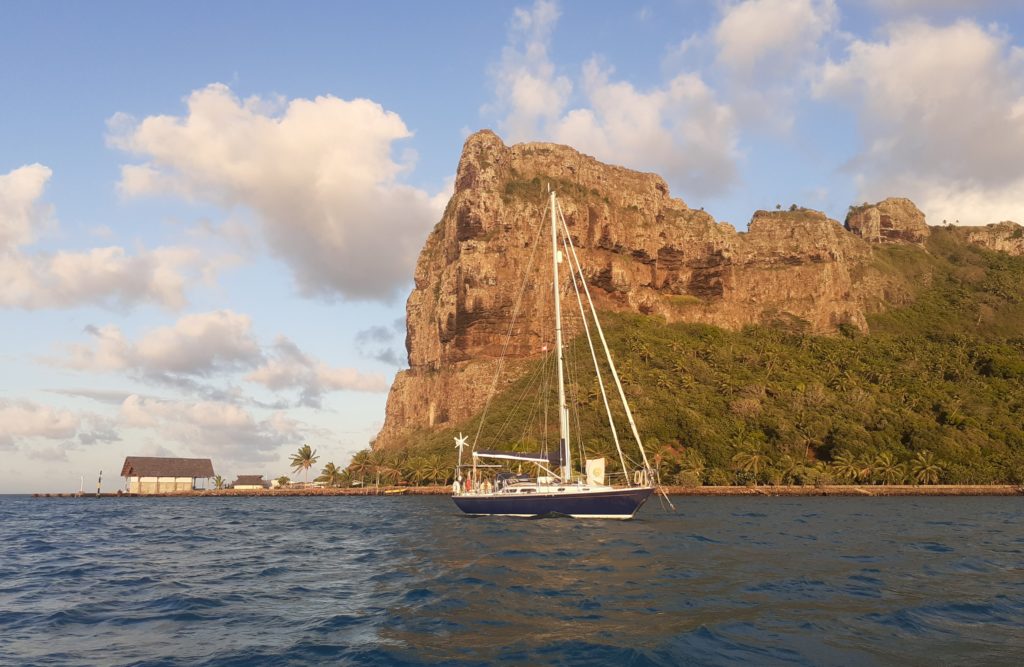
Safely at anchor inside the reef at Maupiti
But sailing wouldn’t be sailing if everything remained perfect and, of course, the wind turned with the reef still four miles away. We could tack but would run out of daylight so reached for the motor starter. Not surprisingly the diesel didn’t start immediately. Lieing an engine on its side and throwing water over it is never going to be helpful. Without an engine, it was impossible to enter the pass straight in to the wind and against the current and Plan B was already being formulated as the engine stuttered to life.
Through the pass, with huge breakers to each side and against the outflowing current, we reached the lagoon and dropped anchor behind the reef and before the backdrop of a stunning pacific dream island. Maupiti!
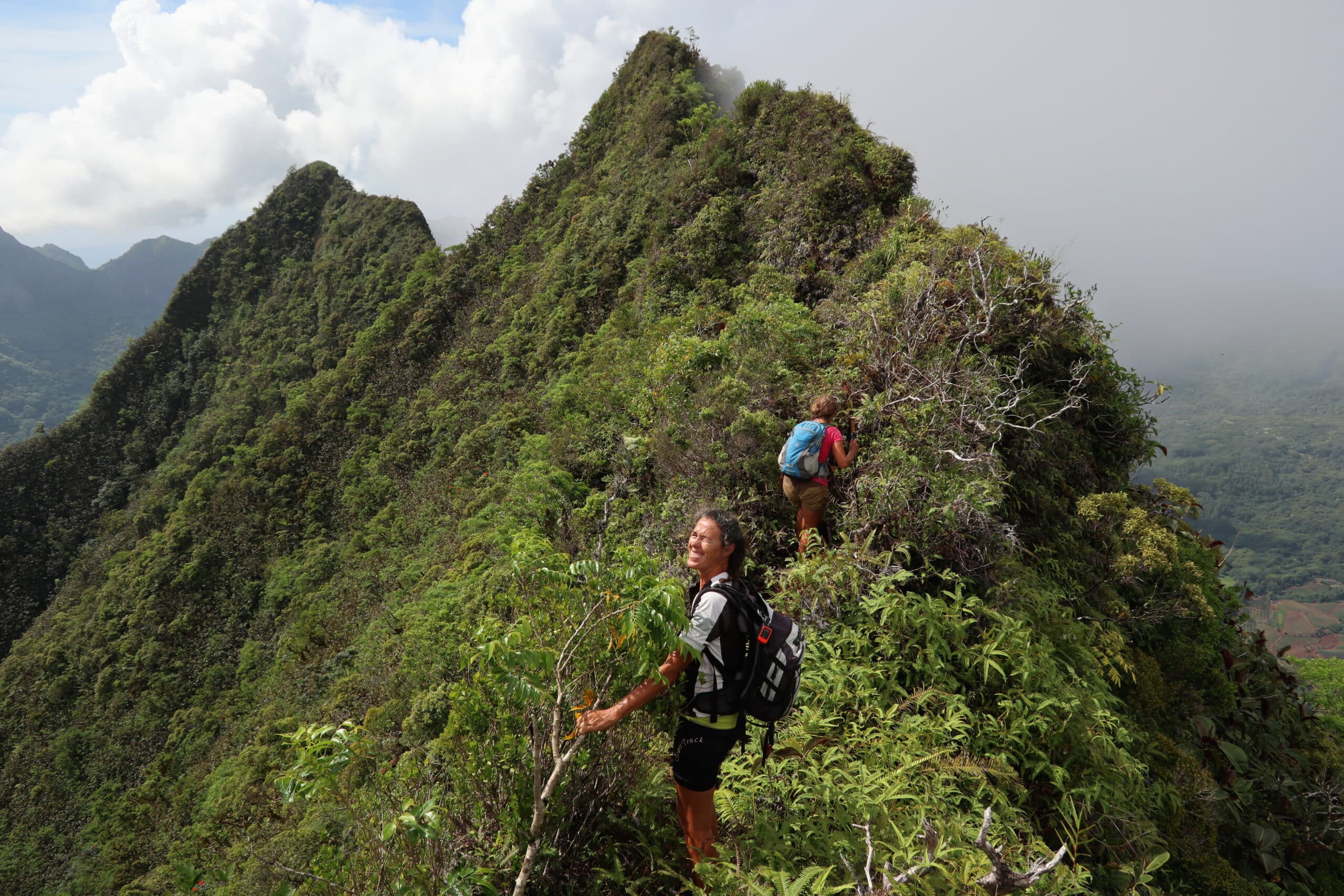
Wir werden jetzt wirklich sportlich 😆😆 die Nomaden (Doris und Wolf) haben uns gefragt, ob wir nicht Lust hätten, mit ihnen auf den Mount Rotui zu kommen. Klar haben wir zugesagt und uns für den nächsten Morgen um 5 Uhr verabredet. Um nicht ganz unvorbereitet zu sein haben wir mal im Internet gegoogelt und gelesen, dass er mit 899 Metern der zweit höchste Berg auf Moorea ist und auch Tritt Sicherheit und Ausdauer verlangt. Zusammen mit den Bellas (Ulrike und Matthias) und Nomaden erklommen wir den ersten Anstieg und waren erstaunt über den schwierigen Weg. Als wir den Aussichtspunkt auf halber Höhe erreicht hatten, haben die Bellas den Rückweg angetreten und Neill als alter Bergführer wollte sie nicht allein gehen lassen und hat sie begleitet. Zum Glück wie sich später heraus stellte haben sie umgekehrt, denn Matthias Schuhe haben sich in seine Einzelteile aufgelöst 😏😲😲.
Doris, Wolf und ich stiegen weiter auf über steile Felsstücke, ausgesetzte Gratwege und einer gewaltigen, von hundert verschiedenen Grüntönen durchzogenen Landschaft mit Blick auf die beiden Buchten und das gesamte Riff. Bei jeder Erhöhung dachten wir, dass muss jetzt der Gipfel sein, doch immer wieder kam der nächste zum Vorschein 🙈🙈. Am Gipfel hüllten uns Nebelschwaden ein und es war eine ganz eigentümliche fast ein bisschen gespenstisch Stimmung ☺️ doch auch wunderschön. Nach einer gescheiten Brotzeit traten auch wir den Abstieg an, der es echt in sich hatte 😜😜. Wolf musste des öfteren auf uns Mädels warten doch nach insgesamt 9 Stunden waren auch wir zurück im Dorf. Doris und ich hatten schon ein bisschen “weiche Knie” und ganz ehrlich war ich nicht traurig wieder unten zu sein 😁. Aber es ist ein ziemlich geniales Gefühl, diesen beeindruckenden Berg anzuschauen und zu wissen, dass du es geschafft hast ihn zu beseitigen und die Aussicht von oben zu genießen 👍👍.
Als wir uns in Makemo entschlossen haben die Hurrikan Saison hier zu verbringen und Neuseeland auf den nächsten Herbst zu verschieben und dafür französisch zu lernen, war mir nicht klar, dass wir auch Polynesisch lernen werden 😲😲. Davon mal ganz abgesehen, dass französisch schon zwei Sprachen sind eine zum sprechen und eine zum schreiben 😁. Doch hier wird auch überall noch Polynesisch gesprochen : Jaurana bedeutet Hallo oder guten Tag; Maururu heißt Danke und Manuja heißt Prost. Für England und für den Rest der Welt hab ich mein Englisch verbessert und weil wir in Spanien spanisch zu sprechen versucht haben bin ich zeitweise ziemlich verzweifelt und verwirrt 🙄🙄Merci, Gracias, thank you oder Maururu. Da sollst du nicht Hirn wirblig werden 😲🙄😜
Aber ich hab ja noch a bissel Zeit um zu üben 😆😆😆.
Durch Verstrickung glücklicher Umstände kamen wir in den Genuss mit Sybo einen Ausflug zum Walwatching zu machen. Jannis, ein Deutscher, der hier in Moore für drei Monate ist hatte eine Einheimische gefunden, die wusste wo die Wale zu finden sind und jetzt brauchten sie nur noch ein Boot 🙈😆. Sybo erklärten sich bereit und luden uns auch dazu ein. Bo war als einziger im Wasser und wir entschlossen uns am Sonntag nochmal zu den Walen zu segeln. Diesmal mit unserer Artemis; wir erreichten die Koordinaten und fanden, genau wie zu erwarten war, gar nichts, also dann trinken wir mal einen Kaffee. Kaum hatten wir unseren Kaffee in den Händen, entdeckte Sybille WALE. 😲😲
Neill brachte uns näher an die Stelle, wo wir sie zuletzt gesehen hatten und dann schwammen wir vielleicht noch 0,5 km und die Wale verschwanden ☹️☹️ aber wir warteten und schauten so ins tief blaue Meer. Plötzlich zeichnete sich der Umriss eines Wales unter uns ab und etwas weißes bewegte sich viel schneller daneben ? 🤔🤔? Bis wir realisierten, dass es eine Walkuh mit ihrem Baby war, war der “Kleine” ( ich schätze ihn auf so ca 5 Meter) schon ganz nahe bei uns. Unglaublich wie neugierig er war, er war so nahe, dass wenn ich die Hand ausgestreckt hätte, ich ihn hätte berühren können. Dann ist er wieder zur Mama abgetaucht, die in ca. 20 Meter Tiefe alles ganz genau beobachtet hat. Es war wie in einem kitschigen Film, das Baby kuschelte sich an die Mama und die Kuh legte den Arm bzw. die Flosse um ihn. Dann tauchte ganz langsam die Walkuh auf und auch ganz ganz nahe. Einfach unglaublich, unbeschreiblich mir fehlen die Worte um diese Gefühle zu beschreiben; diese wunderbaren Tiere eine Armlänge entfernt von uns. Sybille und ich, wir hielten uns an den Händen und waren überwältigt von diesem Erlebnis. Wir schauten die Beiden im Wasser an und sie waren groß , doch außerhalb des Meeres waren sie einfach riesig. Nach ca. 1,5 Stunden schwammen die Wale weiter und Neill holte uns mit dem Boot ab.
An Bord waren wir fast hysterisch, lachten, erzählten und Neill meinte, dass er uns schon von weitem Lachen gehört hat. Er konnte leider dieses Erlebnis nicht mit uns teilen, doch einer musste auf Artemis bleiben und er genoss unsere Erzählungen.
Ich hätte wirklich niemals gedacht, dass mich dieses Erlebniss so beeindrucken würde und dass ich mich so dankbar fühle, so etwas geniales und unbeschreibliches erleben zu dürfen.
A few days ago we awoke to find the famous adventurers from the Austrian sailing yacht Nomad anchored next to us. They had spent the night fighting their way upwind and had arrived in Moorea at first light. Heidi and Wolf were soon yodelling greetings across the water and shortly thereafter they came across in the dinghy to tell us of their plan to scale the 899 meter high Mont Rotui above the anchorage. Of course we were going too!
Two mornings later, at five in the morning, there were six of us at the dinghy dock – the crew of Bella were also looking forward to an invigorating hill walk.
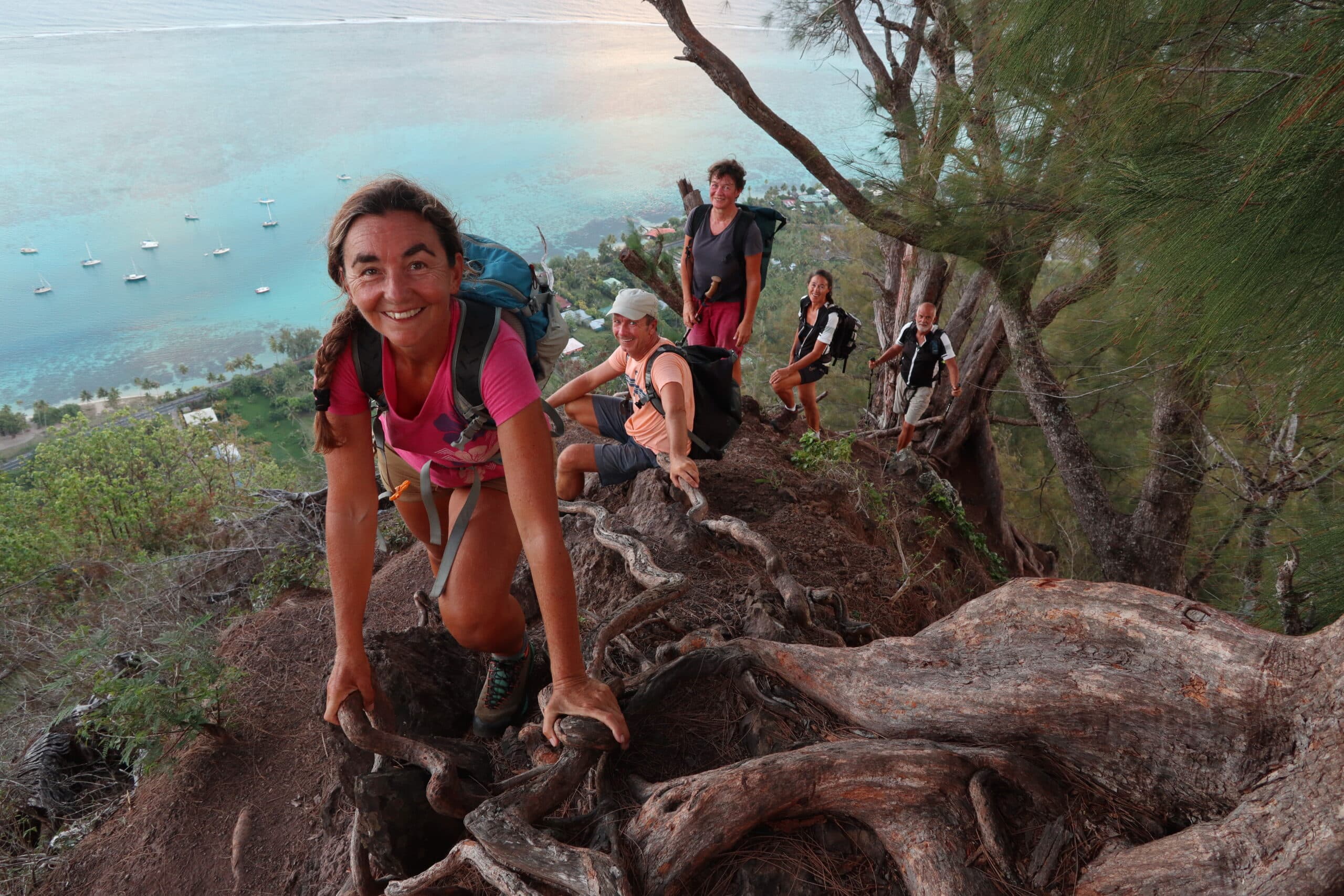
As soon as we turned off the road we realised why the guides describe the route as difficult. It follows the ridge and is a very thin path around and across the basalt mountain. Strenuous and requiring uninterrupted concentration. But when you stopped to look at the views, they were amazing! Mountains, bays, reefs and the Pacific!
We passed a “viewpoint” at about 400 meters and the path got thinner, rougher and slippier. At about 550 meters, after two and a half hours and about half way, we split in to a summit team of Bavarian and Austrian Alpinists and the “rest of the world team” who set off back down. Getting back down took just as long as the climb up and on the way Matthias’ boots began to fall apart. The sea air had obviously eaten the glue and, by the time we were back at the dinghy, the soles were only just attached to the shoes.
Mountains. Cheaper than a drone.
The “mountaineers” reported that, the path had continued to become more challenging and that they reached the summit after over four hours of climbing. But all three agreed that the views were worth the nine hour round trip.